Glass Pre-Roll Tubes: The Premium Packaging Playbook Guide
A glass tube can give customers a clear view of your pre-roll and help a premium product feel considered from the moment they pick it up. But before you settle on a finish or label, there are a few practical questions to answer: will your finished pre-roll fit comfortably, will the cap work for your market, and will the package hold up on its way to the shelf?
This guide brings those decisions together, so you can compare options, request useful samples and build a package that works for your product and your budget.Already have a drawing or sample?Contact YPC with your dimensions, target market and order requirements to discuss suitable options.
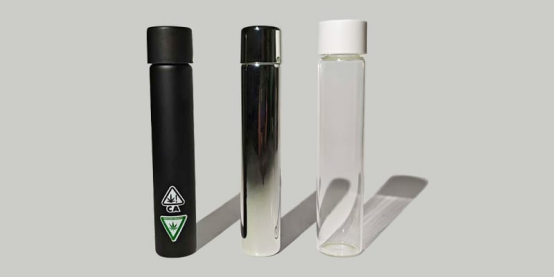
Start with the finished pre-roll
Start with a finished pre-roll from your production line. Measure from the end of the filter to the closed tip, then measure the widest point. If you sell an infused or wrapped product, check whether its coating or shape makes it harder to pass through the tube opening.
| Measurement | Why it matters | Ask your supplier |
| Finished length | The tip needs room when the cap is closed | What is the minimum usable internal length with this closure? |
| Widest product diameter | The pre-roll must pass through the tube neck without catching | What is the minimum opening diameter, including tolerance? |
| Tube body | Too much space may allow movement during handling | What are the internal dimensions and base geometry? |
| Neck and cap | A cap that looks similar may have different threads | Which exact closure is approved for this tube? |
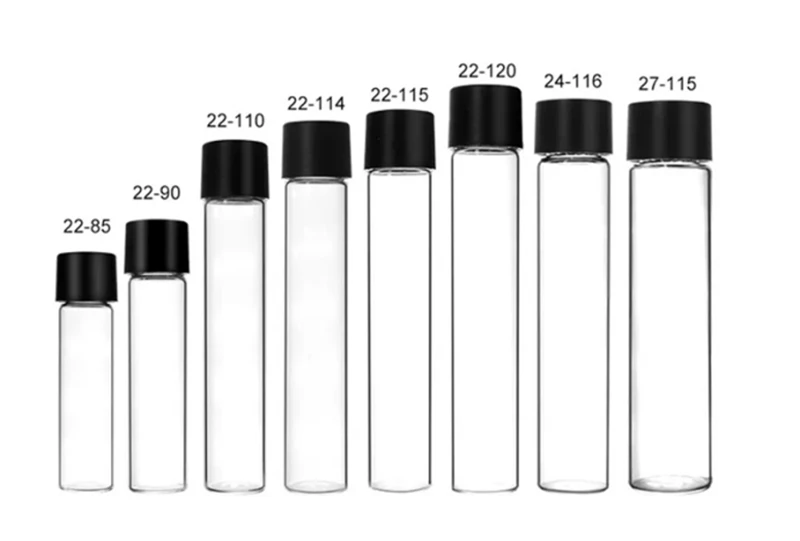
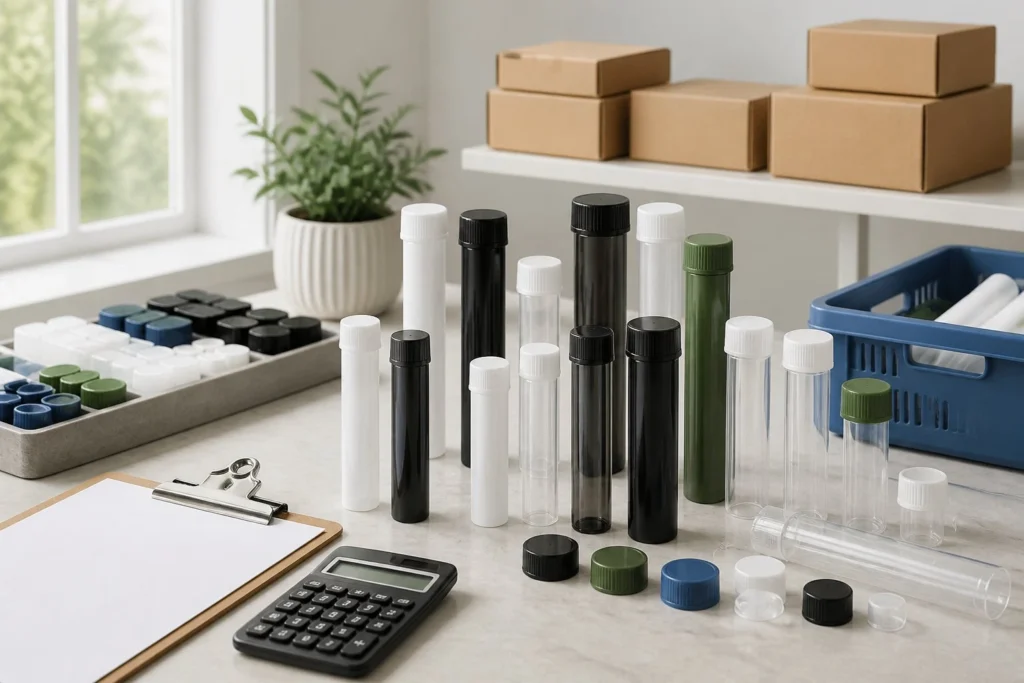
YPC’s glass pre-roll tube range includes several sizes and colors. Its catalog lists tube designations including 22-85, 22-95, 22-115 and 22-120. These are identifiers to discuss with the supplier, not verified usable internal dimensions.
Compare your packaging options
| Option | Where it may suit your range | What to check |
| Clear glass tube | A single pre-roll you want customers to see | Product fit, light exposure, breakage and closure |
| Amber or coated glass tube | A differentiated look or a product needing light protection | Transmission data for the actual glass or coating; labeling rules |
| Wider glass tube | A thicker finished or infused pre-roll | Minimum neck opening, residue and loading performance |
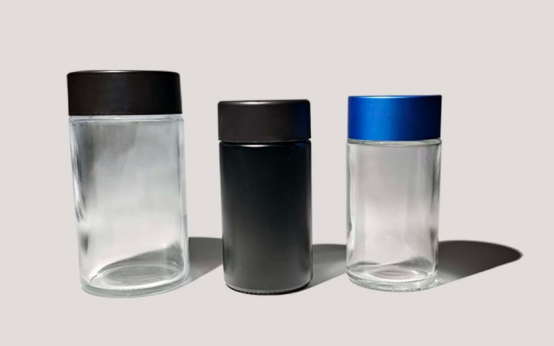
| Glass multipack jar | Several pre-rolls sold together | Arrangement, movement, count and closure fit |
Not sure which format fits?Share your finished-product measurements and destination market with YPC before requesting samples.
What glass can—and cannot—protect
The glass wall gives your product a rigid enclosure and provides a barrier through the container itself. What happens at the opening matters just as much: the cap, liner and any seal all contribute to the performance of the finished package. A glass tube on its own does not establish an airtight seal, odor control or a particular shelf life.
Clear glass is useful for display, but it should not be assumed to provide the light protection a sensitive formulation needs. Amber or other colored glass may reduce transmission of some wavelengths; performance depends on the actual container. Request relevant transmission data and test the finished product in the proposed pack if light exposure matters.
Glass also needs sensible protection in transit. Ask how the tubes are separated inside the case, how much a packed case weighs and what testing is appropriate for your shipping route. Wall thickness is only one part of the picture; it does not guarantee a tube will survive every drop or impact.
Three mistakes that can make a premium pack expensive
Choosing by outside length alone. A tube’s nominal height does not necessarily equal the room available after its cap is closed. Ask for the internal drawing and test representative finished products.
Approving the cap separately. A closure’s appearance or nominal diameter does not establish fit or the scope of a child-resistance test. Verify the full neck finish and the exact tube-and-cap configuration.Comparing only the unit price. Decoration, case packing, freight, breakage, labeling labor and obsolete inventory can change the total cost. Request comparable quotations for the complete delivered package.
Worked example: checking tube fit
Suppose a finished pre-roll measures 108 mm long and 10.5 mm at its widest point. A hypothetical tube has a measured usable length of 114 mm with the cap fitted and a minimum opening diameter of 12.0 mm.
Length difference: 114 − 108 = 6 mm
Diameter difference: 12.0 − 10.5 = 1.5 mm
These numbers are illustrative, not specifications for a YPC product. The 1.5 mm is the total diameter difference, not clearance on each side. Product and packaging tolerances, alignment and handling can reduce the available room. Test samples at representative production limits, including loading, cap closure, removal and transport; there is no universal clearance established by this example.
Closures, decoration and market requirements
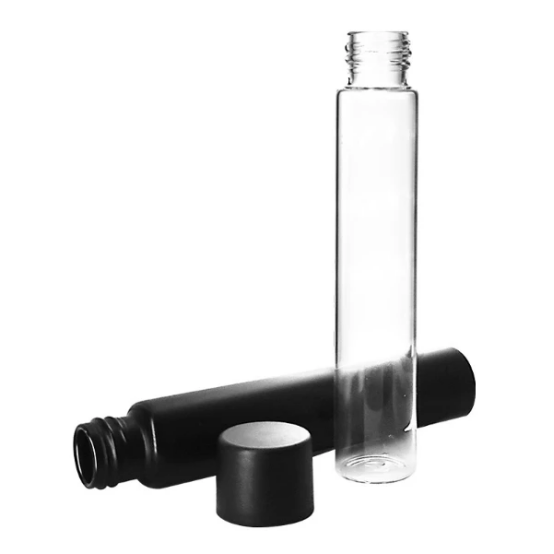
A push-and-turn closure, a cork stopper and a metal cap can create different customer experiences, but the appearance of a closure does not prove how it performs. Child resistance, tamper evidence and seal performance are separate functions.
Requirements depend on the product and destination. For example, Health Canada’s packaging and labelling guide addresses Canadian cannabis packaging. Ask your regulatory team to review each target market and request test documentation covering the exact proposed package. Do not assume that an outer child-resistant bag is accepted everywhere as a substitute for a compliant immediate container.
For branding, compare labels with direct decoration on the actual tube. Labels may make variable information easier to change, while direct printing may suit a stable repeat design. Review the available decoration options, request a physical proof and leave enough room for the required information, barcode and closure operation.
If you are replacing an existing tube, compare the complete neck finish, closure, label panel, case pack and filling-line handling. Reassess the finished package if a component changes. YPC describes general inspection stages on its quality-control page; confirm the tests and acceptance criteria for your order.
Request a quote
| Information | Your project |
| Finished product | Length, widest diameter and number per pack |
| Tube and closure | Preferred material, finish, cap and existing drawing or sample |
| Target markets | Country or state, product category and packaging requirements |
| Decoration | Label or print, artwork, SKU count and required label space |
| Commercial details | Quantity, destination, delivery date and sample or documentation needs |
Send your project details to YPC to discuss glass tubes, compatible closures and samples. A photo or drawing of an existing package can help explain a replacement project.
Frequently asked questions
Do glass pre-roll tubes block UV light?
It depends on the particular glass, color and wavelengths. Ask for transmission data if light protection is important, and evaluate the finished product in its actual package.
Are all glass pre-roll tubes child-resistant?
No. The tube and closure must be evaluated together against the requirements that apply to the product and market. Request documentation for the exact configuration.
Can I reuse the cap from my current tube?
Possibly, but confirm the complete neck finish, fit and any applicable test scope before changing components. Matching nominal diameters alone is not enough.
Are labels or direct printing better for premium tubes?
Either can look good on a premium tube. Labels offer flexibility when product details change; direct printing may suit artwork you plan to reorder. Compare the costs and ask to see each finish on the actual tube before you decide.