Tincture Bottles Guide to Sizes Glass and Droppers
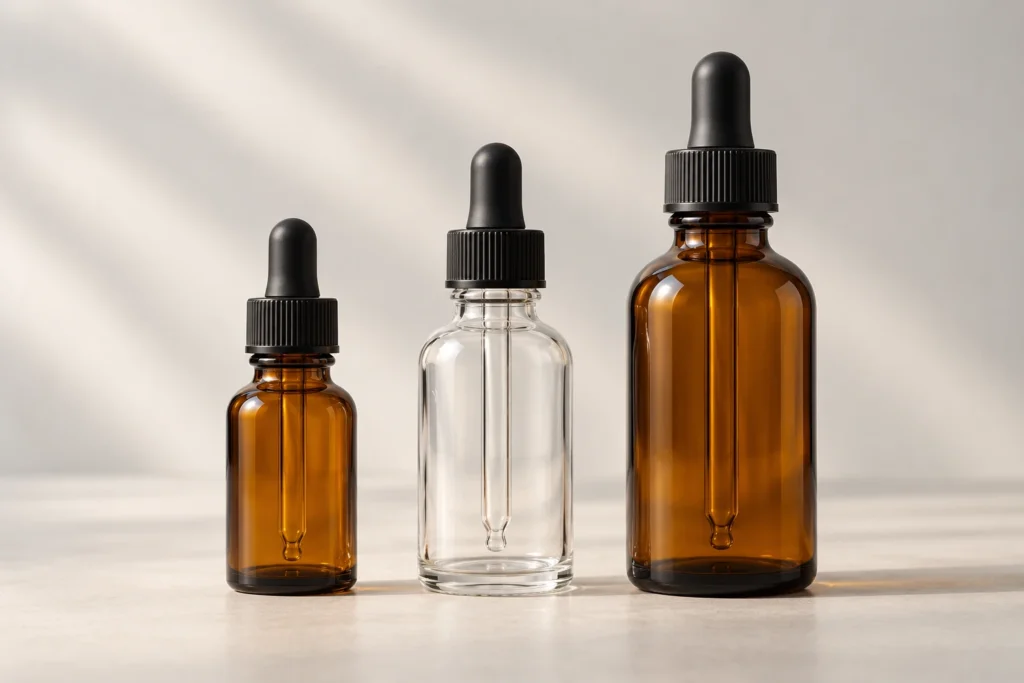
The right tincture bottle must suit both the liquid inside and the way customers dispense it. Start with the formula and required fill volume, then select the glass color, bottle shape and matching closure. Before ordering in bulk, test the complete package with the actual product.
A 30 mL amber glass bottle with a graduated pipette is a useful starting point for many small-volume tincture products. It is not a universal specification. A thicker extract, a larger serving, or a different sales market may call for another capacity or dispensing system.
This guide explains how to compare tincture bottles, check bottle and dropper compatibility, and handle storage, cleaning and reuse without relying on assumptions about size or material.
What is a tincture bottle
A tincture bottle is a small container used to store and dispense a liquid extract. Traditional tinctures are alcohol-based herbal extracts, although packaging catalogs also use the term for some oil-based botanical products and other liquid preparations.
Many tincture bottles combine a glass body with a screw-on bulb and pipette. Others use a dispensing insert or a plain screw cap. The bottle format alone does not establish whether a product is suitable for oral, topical or other use.
Herbal extracts, cosmetic serums and essential oils may share similar-looking packaging, but they can need different contact materials, dispensing instructions and quality controls. Choose the package for its intended contents and use.
Which tincture bottle size should you choose
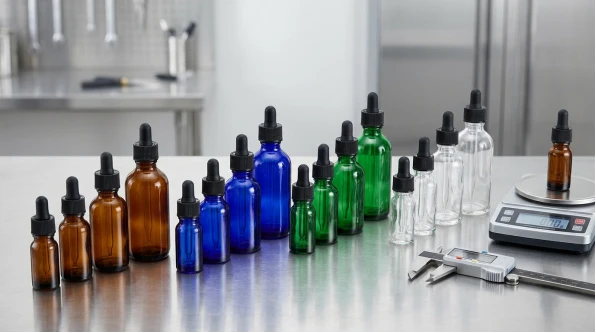
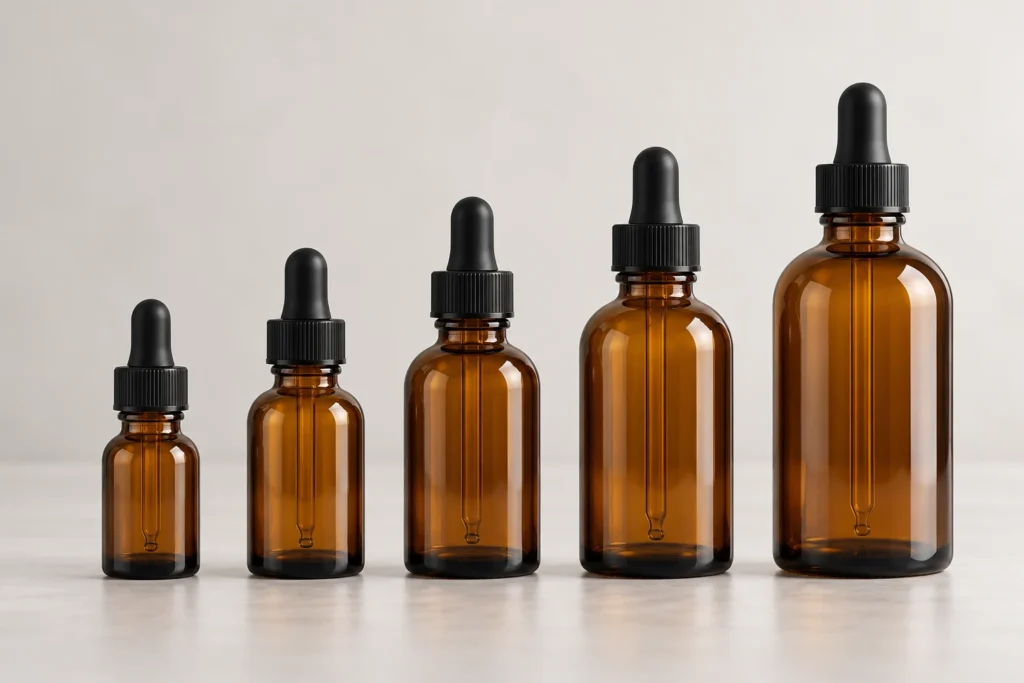
Select capacity from the intended amount per use and the period the bottle should cover. Then check that the selected bottle can accommodate that fill with its closure installed.The table below gives practical starting points, not a rule that every formula should follow.
| Nominal capacity | Approximate US fluid ounces | Possible role in a product range |
| 10 mL | 0.34 fl oz | Small samples or products used in very small amounts |
| 15 mL | 0.51 fl oz | Trial sizes and compact retail packs |
| 30 mL | 1.01 fl oz | A common retail option for tinctures and botanical drops |
| 50 mL | 1.69 fl oz | A larger metric-format option |
| 60 mL | 2.03 fl oz | Larger retail packs where the use rate supports them |
| 100 mL | 3.38 fl oz | Larger-volume products or selected refill formats |
| 120 mL | 4.06 fl oz | Larger packs with a suitable dispensing method |
Packaging suppliers often describe 15, 30, 60 and 120 mL bottles as 0.5, 1, 2 and 4 oz sizes. These are customary approximate pairings. NIST gives one US fluid ounce as approximately 29.57 mL. Imperial fluid ounces differ, so use mL as the primary specification for international purchasing.
For example, if a finished product’s directions specify 0.5 mL per use, a 30 mL fill contains a theoretical 60 uses. This is a packaging calculation, not a dosage recommendation. The usable quantity also depends on filling tolerances and how much product the dispenser can retrieve near the bottom.
Nominal capacity and brimful capacity
Nominal capacity is the stated size of the bottle. Brimful or overflow capacity is the volume it holds when filled to the rim. Suppliers may describe capacity differently, so request both values rather than assuming a fixed allowance.
A pipette occupies space when it enters the filled bottle. The pack may also need headspace for product expansion and handling. Approve the fill level on an assembled sample; filling an empty bottle to the brim does not establish a usable production fill.
How big is a 30 mL or 1 oz tincture bottle
There is no single height or diameter for every 30 mL bottle. Shoulder shape, wall thickness, base design and closure height change its outside dimensions.
For labels and cartons, request the exact bottle drawing and measure a sample with the intended closure fitted. Confirm the body diameter, assembled height and usable label panel before commissioning artwork or packaging inserts.
Glass or plastic for tincture packaging
Glass is widely used for tinctures because it offers good chemical resistance and a strong barrier through the bottle wall. It is a practical material to evaluate for alcohol-based extracts and many botanical oils. Its weight and breakage risk also need to be considered when planning shipping.
Plastic can reduce weight and damage from drops, but suitability depends on the resin, formulation and storage conditions. A statement that all plastic reacts with tinctures is too broad. Likewise, choosing glass does not prove that every component in the package is compatible.
The closure liner, bulb, pipette and any dispensing insert may contact the liquid or its vapor. Review these materials with the supplier and include them in compatibility testing. A bottle can remain intact while a poorly matched seal swells or the bulb loses resilience.
Do not choose glass solely from a description such as “medical-grade.” Ask for the actual glass specification and documentation relevant to the product and destination market. Borosilicate glass is not automatically necessary for a retail tincture bottle, and ordinary packaging glass should not be assumed suitable for boiling or repeated high-temperature treatment.
Amber clear or colored glass
Amber glass is a sensible starting option when a formulation needs protection from light. Compared with clear glass, it can reduce transmission of UV and short-wavelength visible light. Its actual performance depends on the glass and bottle specification.
Clear glass makes the product and fill level easy to see. It may suit a formulation validated for that package, or a packaging system that provides additional light protection. An outer carton helps only while the bottle remains inside it, so consider the customer’s storage after opening as well as the retail display.
Cobalt blue, green and other colors can support brand identification, but appearance alone does not tell you which wavelengths the bottle filters. Frosting is also not equivalent to a tested light-protection specification.
If light sensitivity matters, ask for transmission data for the proposed bottle and test the finished product in that package. Avoid promises such as “blocks all UV” or “extends shelf life by two years” without supporting evidence.
Boston round or Euro dropper bottles
Boston round bottles have rounded shoulders and a familiar cylindrical body. They are available with different neck finishes and closures, including pipettes and screw caps. Their straight body area can be convenient for wraparound labels.
Euro dropper bottles are commonly supplied as part of a matched bottle and closure system. Depending on the model, they may take a dispensing insert, a tamper-evident cap or a compatible pipette assembly. The insert is a separate component; the bottle does not inherently contain a built-in dropper.Neither shape guarantees a better seal. The exact neck finish, closure design and assembled fit determine performance. Choose the shape after considering dispensing, label space, filling equipment and the available matching components.
How to match a bottle and dropper

Check the neck finish, pipette length and complete bottle and closure fit. Concept illustration.
Treat the bottle and closure as an assembly. Matching a cap by appearance or nominal bottle volume can lead to leaks, poor dispensing or a pipette that does not fit.
Check the full neck finish
“20 mm” describes only part of a specification. A complete designation such as 20-400 identifies a particular neck finish. Bottles of the same capacity may instead use another finish, including an 18-DIN design.
Confirm the supplier’s complete bottle and closure specifications. Do not assume that a dropper from a 15 mL bottle fits a 60 mL bottle, or that two caps with the same nominal diameter are interchangeable.
Confirm pipette length and dispensing behavior
The pipette should reach far enough into the bottle to retrieve product while retaining clearance from the glass base. Ask the supplier to specify a pipette for the exact bottle, then test it when the pack is full and nearly empty.
Liquid viscosity, pipette geometry and bulb action all affect the amount drawn and released. Test for slow filling, trapped air, dripping and residue around the neck. Thick or particle-containing formulas may need a different dispenser.
A graduated pipette helps users measure volume, but printed marks alone do not establish accuracy. If the product instructions require a specific volume, verify delivery with the intended formula and assembly. One squeeze is not automatically 1 mL, and a drop is not a fixed unit of volume.
Distinguish child resistance from tamper evidence
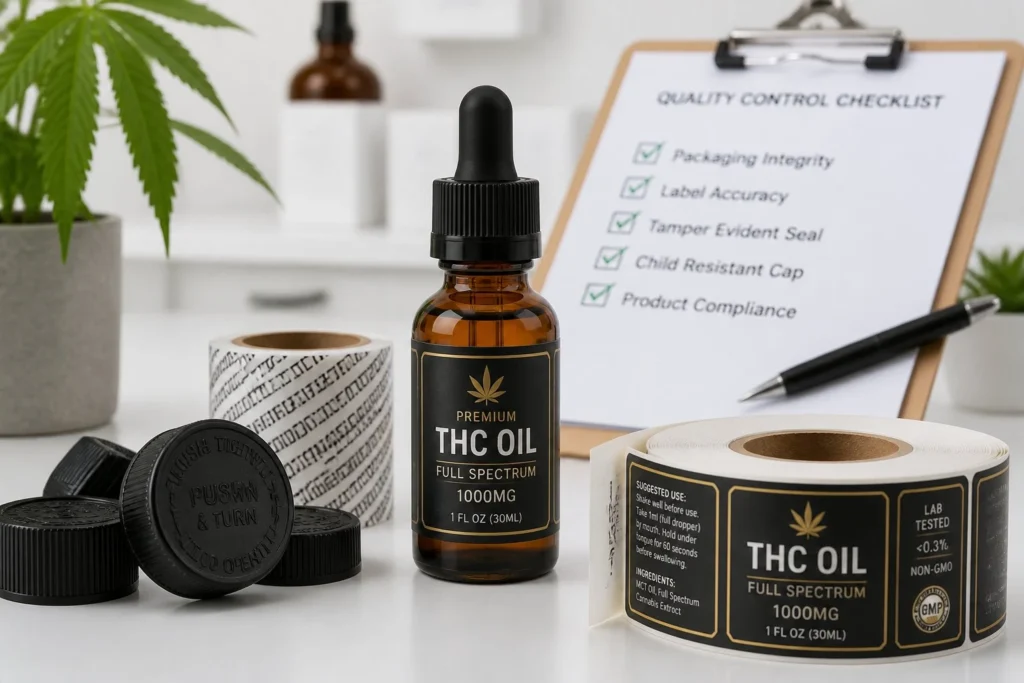
A tamper-evident band or closure indicates that a pack may have been opened. Child-resistant packaging is designed to make access more difficult for young children. These are different functions.
Requirements depend on the product and destination market. When child resistance is needed, request evidence covering the proposed packaging configuration. Australia’s TGA guidance explains that child resistance relates to the package as a whole, rather than just a closure. In the United States, the CPSC special packaging guidance describes a separate regulatory framework. Neither should be treated as a universal rule for every tincture sold worldwide.
What to check before ordering in bulk
Request samples of the bottle and matching closure before approving a production order. A photograph cannot establish formula compatibility or shipping performance.
| Check | What to confirm |
| Fill and capacity | The declared fill fits with the pipette installed and the agreed headspace |
| Bottle and closure fit | Correct neck finish, even seating and supplier-specified closing conditions |
| Dispensing | Suitable draw, release and product retrieval with the actual formula |
| Compatibility | Bottle and contact components remain suitable over the planned storage period |
| Leakage and transport | Filled packs perform under the expected shipping and handling conditions |
| Artwork | Labels fit the approved panel and remain readable after expected handling |
| Documentation | Material details, traceability and market-relevant evidence match the ordered components |
Agree the test conditions and acceptance criteria with your filling partner and packaging supplier. A quick leak check is useful for rejecting a bad fit, but it does not replace stability or compatibility work over time.
Compare quotations on the same basis. Confirm whether the price includes the bottle, complete dropper, decoration, protective packing and assembly. Ask separately about minimum order quantity, sample approval, production lead time and delivery terms.
For custom tincture bottles, approve the functional assembly before finalizing color, printing or decorative collars. A change to the closure or bottle geometry can affect the carton, label and filling setup.
Labels and packaging for international sales
A small bottle must leave enough readable space for its product information. Establish the target markets and product category before deciding on a label layout. Requirements for a cosmetic, food supplement or medicine may differ even when the bottles look identical.
Plan space for the information your product requires, which may include identity, ingredients, net contents, directions, warnings, batch identification and responsible business details. This is a layout planning list, not a universal legal checklist. Additional languages can change the available space considerably.
Request the usable label-panel drawing rather than scaling artwork from another bottle. Test label adhesion and print durability against normal handling and likely splashes of the finished product. If a carton or multilayer label is needed, confirm which information must remain on the primary container in each market.
Storing and caring for tincture bottles
Follow the finished product’s storage instructions and expiry information. A dark bottle cannot compensate for excessive heat, a damaged seal or unsuitable storage conditions.
Keep the closure properly secured between uses and protect the bottle from direct sunlight when instructed. Avoid touching the pipette tip to the mouth, skin or other surfaces. Inspect the closure for visible deterioration and check the bottle for leakage or damage.
Do not assign every tincture the same three-to-five-year shelf life. Alcohol level, water content, ingredients, preservation, packaging and use after opening all affect the appropriate storage period. Commercial shelf-life claims should be supported by evidence for the finished product in its intended pack.
Cleaning reusing and recycling empty bottles
An intact glass bottle may be reusable, but whether it is suitable depends on its previous contents, the intended new use and the manufacturer’s instructions. A container previously used for cosmetics or chemicals should not be repurposed for an ingestible product.
For manufacturer-approved household reuse, remove accessible residues using the recommended cleaning method, rinse as directed and allow every component to dry completely. Separate parts only if the assembly is designed to come apart. Replace components that retain residue or show damage, and do not run fingers over a chipped glass rim.
Cleaning, disinfection and sterilization are different processes. CDC guidance notes that alcohol does not destroy bacterial spores; that does not make it a universal treatment for food-contact bottles or rubber bulbs. Follow instructions appropriate to the component and intended use rather than applying a generic boiling or alcohol-soaking recipe.
For commercial refilling, use a documented process appropriate to the product, including inspection, cleaning controls and traceability. Household washing is not evidence that a returned package is ready for production.
When disposing of empty packaging, follow local collection rules for the glass bottle and its mixed-material closure. Small pipettes, bulbs and caps may be handled differently from container glass. Do not assume that every part belongs in the same recycling stream.
Frequently asked questions
Is amber the best color for every tincture
Amber is a useful starting point for light-sensitive formulas. The best choice still depends on the product’s stability requirements and the measured performance of the complete package. Clear or other colored glass needs the same assessment.
How many drops are in a 30 mL bottle
There is no fixed total. Drop size changes with the liquid and dispensing tip. For a labeled volume per serving, use a suitable measuring device and verify its performance rather than converting from an assumed drops-per-mL value.
Can one dropper fit several bottle sizes
Sometimes, but only if the neck finish and assembly dimensions match. A cap that fits may still carry the wrong pipette length. Confirm compatibility for each bottle model.
Do new tincture bottles need sterilizing
New does not automatically mean sterile or ready to fill. Ask the supplier how the packaging is supplied, then use the preparation process required for your product and filling operation. Not every product requires sterilization, and not every bottle or closure tolerates the same treatment.
Does a food-grade claim cover the whole package
Do not assume it does. Request documentation relevant to the intended contents and contact conditions for the bottle and applicable closure components. A claim about the glass body alone does not establish the suitability of the complete dropper assembly.
Discuss your tincture packaging requirements
Before requesting a quote, prepare your target fill volume, formula type, intended amount per use, destination markets, closure requirements and order quantity. Include any label or carton constraints so they can be considered alongside the bottle.
Explore our dropper cap options or contact our packaging team to discuss a bottle and closure combination for your project. Confirm the specification and filled samples before committing to bulk production.