Wholesale Glass Tincture Bottles Buyer’s Guide: Sizes, UV Protection, Dropper Specs & Factory QC
Anyone can sell you a glass bottle that looks good in a studio photo. The real test happens three weeks later—when those bottles hit your automated filling line, sit under retail spotlights, or spend a month vibrating inside an ocean freight container.
When you order wholesale glass tincture bottles for CBD oils, THC extracts, herbal tinctures, or essential oil blends, a small specification oversight gets expensive fast. Over the past 15 years at our factory, we have helped dozens of brands recover after losing thousands of dollars to swollen rubber bulbs, paper labels peeling off from spilled MCT oil, or caps that backed off during transit. Sourcing reliable custom cannabis packaging comes down to locking in four practical details before you place a bulk order: bottle geometry, UV spectral protection, dropper chemical compatibility, and pre-shipment quality control.
Key Takeaways Before You Place a Bulk Order
- Standardize your neck finishes: Stick to 18-415 for 15ml bottles and 20-400 for 30ml and 60ml bottles so you can share the exact same caps and bulbs across multiple product lines.
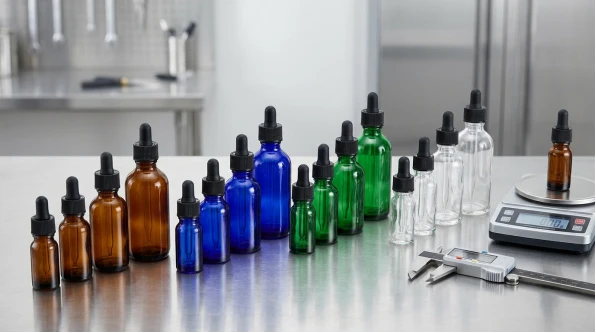
- Prioritize true UV-blocking glass: Kiln-melted amber glass blocks 99% of UV light below 450nm, while opaque black or violet UV glass blocks virtually 100% of visible and ultraviolet light for ultra-sensitive extracts.
- Match the rubber bulb to your carrier solvent: Standard natural rubber swells and turns sticky when exposed to MCT oil, terpenes, or alcohol. Specify Nitrile (NBR) or Platinum-Cured Silicone bulbs instead.
- Verify factory torque and leak testing: Require 8–12 in-lbs of application torque for standard droppers (8–15 in-lbs for child-resistant caps) and -0.06 MPa vacuum seal checks before shipment.
Size & Capacity Matrix: Matching Volume to Your Filling Line
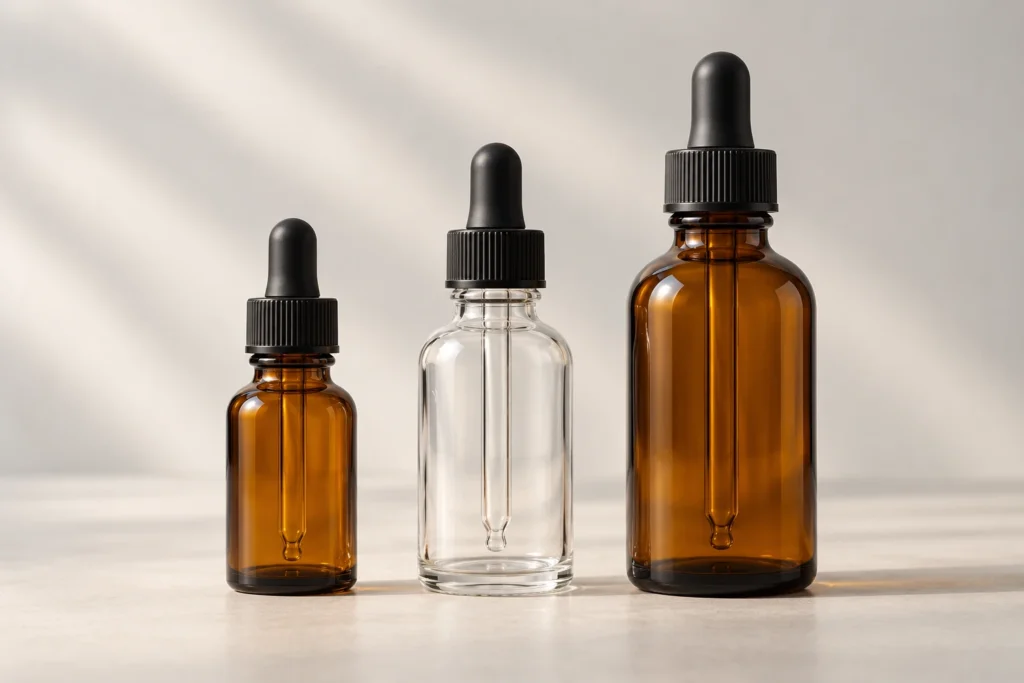
When buyers ask our engineering team which bottle size to start with, our first question is always: what is your recommended daily dose, and what type of filling nozzles are you running? Choosing a bottle that is too large for your fill volume leaves excessive headspace (trapped air), which oxidizes delicate cannabinoids, terpenes, and carrier oils every time the consumer opens the cap.
Reviewing the complete glass type and dimensions for cannabis tincture bottles ensures your bottles fit smoothly on automated capping equipment, inside folding cartons, and on retail shelves.
Detailed Sizing & Neck Finish Breakdown
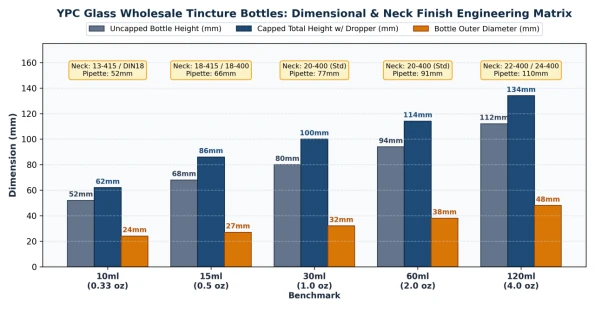
| Capacity | Uncapped / Capped Height | Diameter (Approx.) | Common Neck Finish | Pipette Length | Primary Commercial Application |
| 10ml (0.33 oz) | 52mm / 62mm | 24mm | 13-415 / DIN 18 | 52mm | Discovery samples, potent concentrates, travel kits |
| 15ml (0.5 oz) | 68mm / 86mm | 27mm | 18-415 / 18-400 | 66mm | High-potency CBD drops, facial serums, 15-day regimens |
| 30ml (1.0 oz) | 80mm / 100mm | 32mm | 20-400 | 76mm–78mm | Industry benchmark (30-day supply at 1ml daily dose) |
| 60ml (2.0 oz) | 94mm / 116mm | 38mm | 20-400 | 89mm–91mm | Value retail SKUs, high-dose formulas, subscription refills |
| 120ml (4.0 oz) | 112mm / 134mm | 48mm | 22-400 / 24-400 | 110mm | Bulk retail value packs, clinical backbar dispensing |
15ml (0.5 oz) — Concentrates & Trial Sizes
If your formula only requires 3 to 5 drops per serving, a larger bottle feels half-empty and drives up your per-unit air freight costs. Our 15ml amber glass round bottles with black bulb glass dropper feature a compact 18-415 neck finish that pairs cleanly with slim pipettes and reducer inserts. Because this neck opening is narrower than larger bottles, always match your closures specifically to the 18-415 thread pattern.
30ml (1.0 oz) — The Industry Benchmark
Roughly 70% of all tincture packaging orders we manufacture are 30ml bottles. At a standard dose of 1ml per day (approximately 20 drops from a standard glass pipette), a 30ml bottle delivers an intuitive 30-day supply that consumers immediately recognize and trust. While classic Boston rounds with a 20-400 neck finish are the industry staple, brands looking for stronger shelf differentiation and flat anti-roll labeling panels frequently choose a 30ml amber square essential oil glass bottle with dropper or a modern flat-shoulder cylinder.
60ml (2.0 oz) & 120ml (4.0 oz) — Value Sizes & Inventory Standardization
Larger 60ml and 120ml bottles are ideal for lower-potency formulas requiring higher daily doses, family-size value packs, or monthly subscription refills. Notice how the 60ml Boston round doubles the liquid capacity of the 30ml bottle while keeping the exact same 20-400 neck finish. In GPI packaging standards, ’20-400′ denotes a 20mm outer thread diameter with a 400-style single-turn continuous thread.
By standardizing both your 30ml and 60ml product lines on a 20-400 neck finish, your operation can purchase the exact same caps, collars, and rubber bulbs for both SKUs—only changing the glass pipette length (76mm for 30ml vs. 89mm for 60ml). Also keep in mind when designing outer paperboard cartons that a 60ml bottle stands roughly 94mm (3.7 inches) uncapped, but reaches 116mm (4.6 inches) once the dropper assembly is torqued down.
| Need to Test Cap Fit and Filling Line Compatibility? Do not guess on thread tolerances or folding carton heights. Tell us which capacities you are planning to run—we ship free physical sample kits from our 30,000+ ready molds within 3 days so your team can test torque and label fit on your own line. Request Free Physical Samples from YPC Packaging |
Glass Color & UV Protection: Preventing Formula Degradation
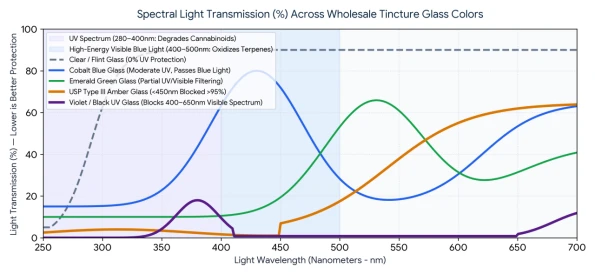
Ultraviolet rays (280–400nm) and high-energy visible blue light (400–500nm) rapidly break down cannabinoids, oxidize carrier oils, and strip away volatile terpenes, retinol, and vitamin C. Stability testing demonstrates that cannabis extracts stored in clear glass containers can lose up to 30% of their active cannabinoid potency within six months. Comparing amber vs. cobalt blue glass UV protection levels as well as choosing between amber, clear, frosted, and black UV glass helps you balance shelf appeal with chemical stability.
Amber Glass (USP Type III Pharmaceutical Standard)
Amber glass is the undisputed workhorse for herbal, nutraceutical, and cannabis tinctures. Produced by blending iron, sulfur, and carbon directly into the molten glass batch, true amber glass blocks 99% of UV light below 450nm. It meets USP Type III and European Pharmacopoeia standards for chemical resistance and leachables while remaining translucent enough for customers to see the liquid level inside.
Black & Violet UV Glass (Maximum Spectral Shield)
For ultra-premium, preservative-free full-spectrum extracts or high-terpene rosin drops retailing above $60, opaque black or biophotonic violet UV glass blocks virtually 100% of visible and ultraviolet light, offering the longest possible shelf life without requiring secondary packaging.
Cobalt Blue, Emerald Green & Clear / Frosted Glass
Cobalt blue and emerald green bottles create striking visual differentiation on retail shelves and block a moderate portion of UV radiation, though they still allow blue and violet light wavelengths to pass through. Clear (flint) glass and acid-frosted glass scatter or transmit light without filtering UV rays; they are an excellent choice when showcasing oil clarity is your top priority and the bottle is sold inside a light-blocking folding carton.
Melt-Colored Glass vs. Spray-Coated Glass
Melt-colored glass has its pigment fused throughout the entire glass wall inside the furnace, meaning its UV barrier will never fade, scratch, or peel during high-speed washing and filling. Spray-coated glass starts as clear flint glass and receives an exterior color or matte coating afterward; while ideal for custom Pantone brand colors and gradients, sprayed coatings require strict cross-hatch adhesion and alcohol-rub QC testing.
| Want to Compare Your Artwork on Amber, Matte Black, or Frosted Bottles? Send us your logo or label files. Our in-house engineering team turns concepts into 2D drawings in 1 day and delivers photorealistic 3D renderings in 2 days—free of charge—so you can evaluate every glass finish before tooling. Get Your Free Custom 3D Bottle Rendering |
Dropper & Closure Engineering: Pipettes, Bulbs & CR Compliance
Most post-launch packaging complaints—from leaking shipments to dissolved rubber bulbs—trace back to the closure assembly rather than the glass bottle itself. When selecting custom dropper caps and closures, every component must be engineered around your liquid viscosity and solvent chemistry.
Pipette Styles & Kiln-Fired Graduated Markings
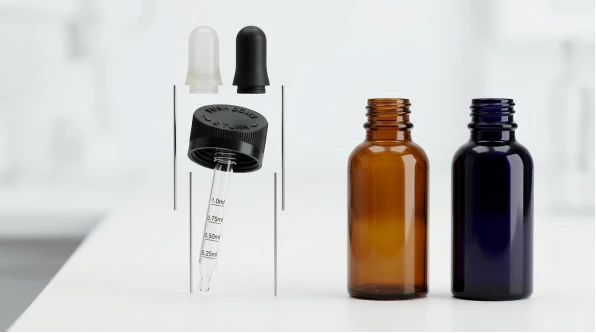
Unlike plastic pipettes that can leach or warp when submerged in high-terpene extracts or alcohol, glass pipettes remain chemically inert. You can configure your dropper assembly with straight-tip pipettes for standard tinctures, curved-tip or ball-tip pipettes (such as 0.35ml or 1.0ml dosing bulbs) for thicker carrier oils, or Euro dropper orifice reducers for drop-by-drop essential oil dispensing.
To eliminate the frustration of counting 20 individual drops per 1ml dose, we recommend graduated glass pipettes printed with 0.25ml, 0.50ml, 0.75ml, and 1.0ml measurement lines using high-temperature kiln-fired ceramic ink that will never flake off into your oil. Also verify that the pipette tip sits 1.5mm to 2.5mm above the interior bottle base so it draws up the final drops without striking the glass bottom during capping.
Rubber Bulb Chemical Compatibility (NR vs. NBR vs. Silicone)
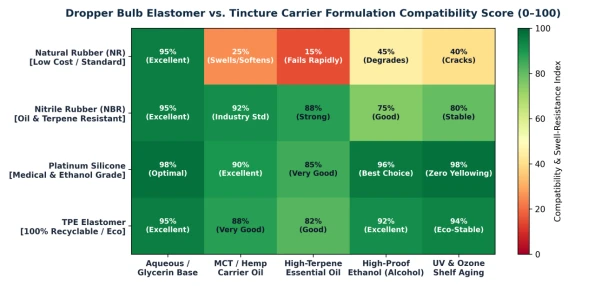
Standard Natural Rubber (NR) bulbs work well for water-based serums, but they swell, soften, and degrade within weeks when exposed to MCT coconut oil, hemp seed oil, citrus terpenes, or high-proof ethanol. For oil-based tinctures and essential oils, always specify Nitrile Butadiene Rubber (NBR) bulbs. For high-proof alcohol tinctures or custom Pantone-matched closures, choose medical-grade Platinum-Cured Silicone or 100% recyclable TPE bulbs.
Child-Resistant (CR) & Tamper-Evident Closures
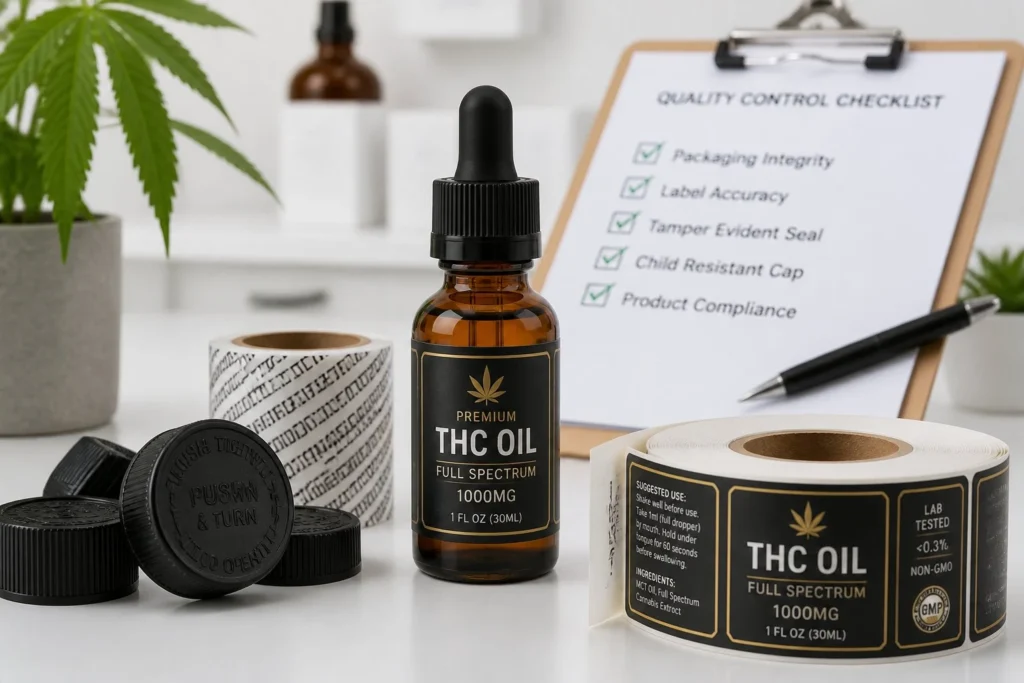
Cannabis tinctures and regulated pharmaceuticals require child-resistant closures certified under the US Poison Prevention Packaging Act (16 CFR 1700) and ISO 8317—verified to prevent at least 85% of children under five from opening the bottle within five minutes while allowing 80% of adults to open and reseal it properly. Reviewing our guide to push-and-turn vs. squeeze-and-turn child-resistant caps will help you pair push-and-turn CR dropper caps with breakable tamper-evident (TE) rings or shrink bands for complete retail compliance.
Factory Quality Control, OEM Customization & Shatter-Proof Logistics
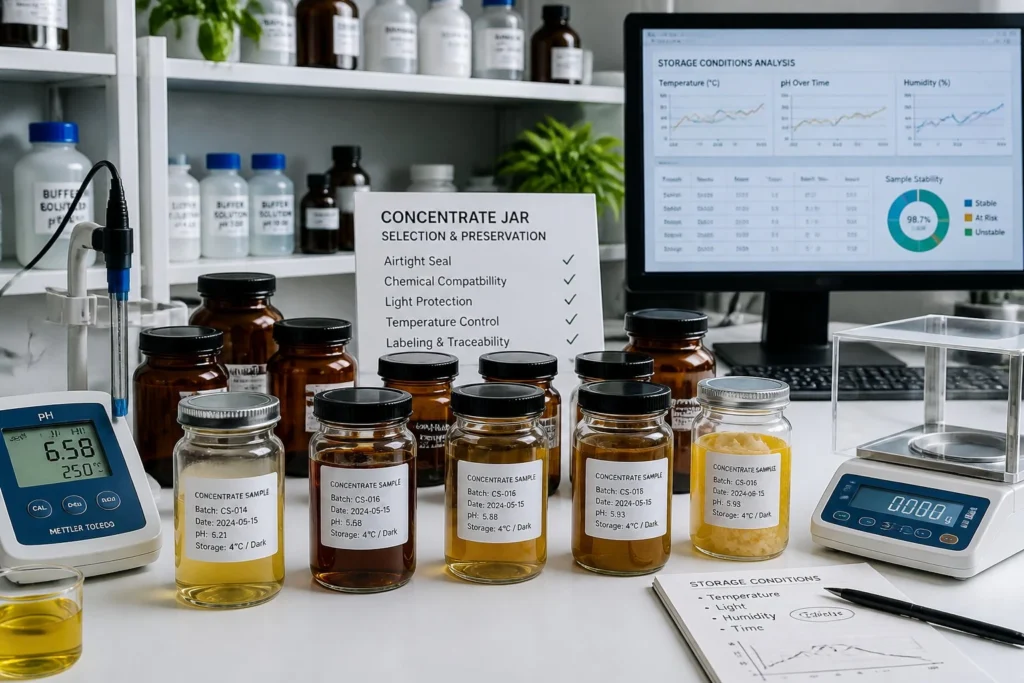
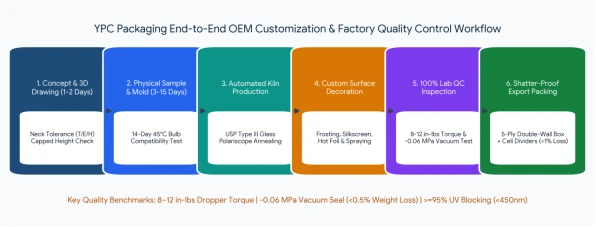
Unlike packaging brokers who outsource to multiple workshops, YPC Packaging operates our own ISO 9001-certified glass furnaces, plastic cap injection facilities, and surface decoration plants. Every production batch undergoes strict cap torque and seal integrity testing standards with full Certificate of Analysis (COA) documentation:
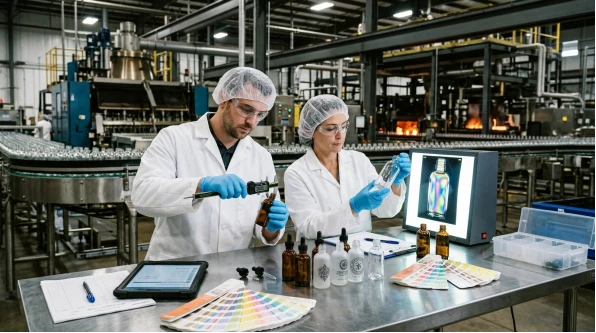
- Calibrated Torque & Vacuum Leak Testing: We test application and removal torque on every run—maintaining 8–12 inch-pounds for standard droppers and 8–15 inch-pounds for child-resistant caps—followed by 24-hour inverted leak checks and -0.06 MPa vacuum chamber tests requiring less than 0.5% weight loss.
- Wall Thickness, Polariscope Annealing & Soda-Lime / Borosilicate Options: Every lot is inspected with digital calipers for neck thread accuracy and polariscopes for internal thermal stress. We supply both FDA GRAS-compliant soda-lime glass and thermal-shock-resistant borosilicate glass.
- Oil-Proof Labeling & Direct Glass Decoration: Because spilled carrier oils quickly stain and peel standard paper labels, we offer BOPP/vinyl oil-proof labels as well as direct silk-screen printing, acid frosting, hot foil stamping, electroplating, and spot UV finishes—with prototype molds ready in 15 days and mass production completed in 20 days (or 7 days for urgent small bulk orders).
- Shatter-Proof Export Packaging: To prevent transit breakage, our shatter-proof shipping and bulk packaging solutions utilize 5-ply double-wall corrugated cartons with individual cell partitions, pack glass bottles and dropper pipettes in separate boxes, and secure every pallet with corner boards and heavy-gauge stretch wrap.
Frequently Asked Questions
What are the most common tincture bottle sizes for wholesale orders?
Wholesale buyers primarily order 5ml, 10ml, 15ml, 30ml, 60ml, and 120ml bottles. The 30ml (1 oz) Boston round is the industry benchmark, holding a standard 30-day supply at 1ml per day. Smaller 10ml and 15ml sizes are ideal for samples and high-potency concentrates, while 60ml and 120ml sizes serve value retail packs and high-daily-dose regimens.
What are the exact dimensions of a standard 30ml glass tincture bottle?
A standard 30ml Boston round glass tincture bottle measures approximately 80mm tall uncapped (and 98mm–102mm tall once the dropper assembly is installed) with an outer diameter of 31mm–33mm. It typically uses a 20-400 or 18-400 neck finish. Always build your folding carton die-lines around the fully capped height plus 2–3mm of top clearance.
Which glass color provides the best UV protection for tinctures?
Kiln-melted amber glass and opaque black/violet UV glass provide the strongest UV protection. USP Type III amber glass blocks 99% of UV light below 450nm while allowing customers to see the fill level, whereas black or violet UV glass blocks virtually 100% of visible and ultraviolet light for ultra-sensitive formulations.
Why do rubber dropper bulbs swell or get sticky with CBD and essential oils?
Standard natural rubber (NR) absorbs carrier oils like MCT coconut oil, hemp seed oil, citrus terpenes, and ethanol, causing the bulb to swell, soften, and lose suction within weeks. Upgrading to Nitrile Butadiene Rubber (NBR) or Platinum-Cured Silicone bulbs eliminates swelling and chemical leaching.
What quality-control checks should be performed before bulk tincture bottles ship?
Your manufacturer should provide batch inspection reports covering dimensional caliper checks (neck finish T/E/H tolerances and wall thickness), polariscope annealing stress tests, application/removal torque checks (8–12 in-lbs for standard droppers, 8–15 in-lbs for CR caps), and -0.06 MPa vacuum leak testing with under 0.5% weight loss.
| Ready to Source Leak-Free Wholesale Glass Tincture Bottles at Factory-Direct Pricing? Work directly with a 100% vertically integrated glass & closure manufacturer (84,000+ daily output, 30,000+ ready molds, and 300+ in-stock designs): • Free 2D Concept Drawing in 1 Day & Free 3D Rendering in 2 Days • Free Physical Sample Kits Shipped in 3 Days (Test our NBR & Silicone droppers with your own oil) • 7-Day Expedited Small Bulk Orders & 20-Day Full Mass Production Send us your target bottle size, glass color, closure style, and estimated order volume: Contact YPC Packaging for a Fast Wholesale Quote & Free Samples |