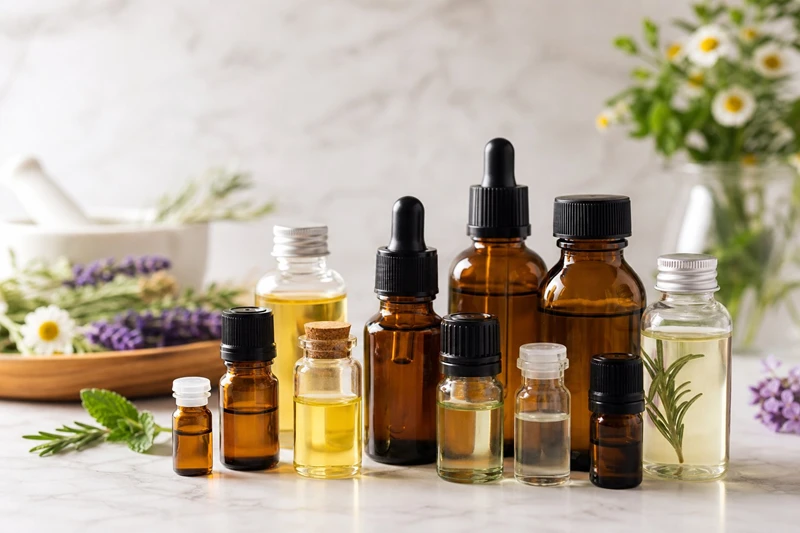
The Complete Guide to Essential Oil Bottles
In the essential oil industry, packaging is not simply a container — it is a protection system, a dispensing tool, and a brand statement.
Essential oils, CBD extracts, and terpene blends are volatile and highly sensitive to light, oxygen, and environmental changes. The wrong packaging can shorten shelf life, cause leakage, alter aroma profiles, and damage customer trust.
The right essential oil bottles protect product integrity, ensure safe dispensing, and reinforce your brand’s positioning in a competitive global market.
Whether you are:
- Launching a new aromatherapy brand
- Scaling a CBD oil product line
- Selling on Amazon or Shopify
- Sourcing essential oil bottles wholesale
This comprehensive guide will walk you through the key technical and commercial factors behind professional glass packaging decisions.
At YPC Packaging, we specialize in glass packaging for cannabis and cosmetic industries, supplying matched bottle + closure systems with strict quality control and MOQ starting at 3,000 pieces.
If you are currently evaluating packaging partners, you can Contact Us for Samples or Technical Drawings at any time.
What Are Essential Oil Bottles?
Essential oil bottles are small-capacity glass containers engineered for storing concentrated botanical extracts, CBD oils, terpenes, and cosmetic actives.
Unlike general liquid packaging, they must provide:
- UV resistance
- Airtight sealing
- Chemical compatibility
- Precision dispensing control
Glass remains the industry standard because it is non-reactive, impermeable, and stable during long-term storage.
For material comparison insights, see Glass vs Plastic Essential Oil Bottles.
Types of Essential Oil Bottles
Although the market offers many variations, four primary bottle types dominate global essential oil bottles wholesale demand.
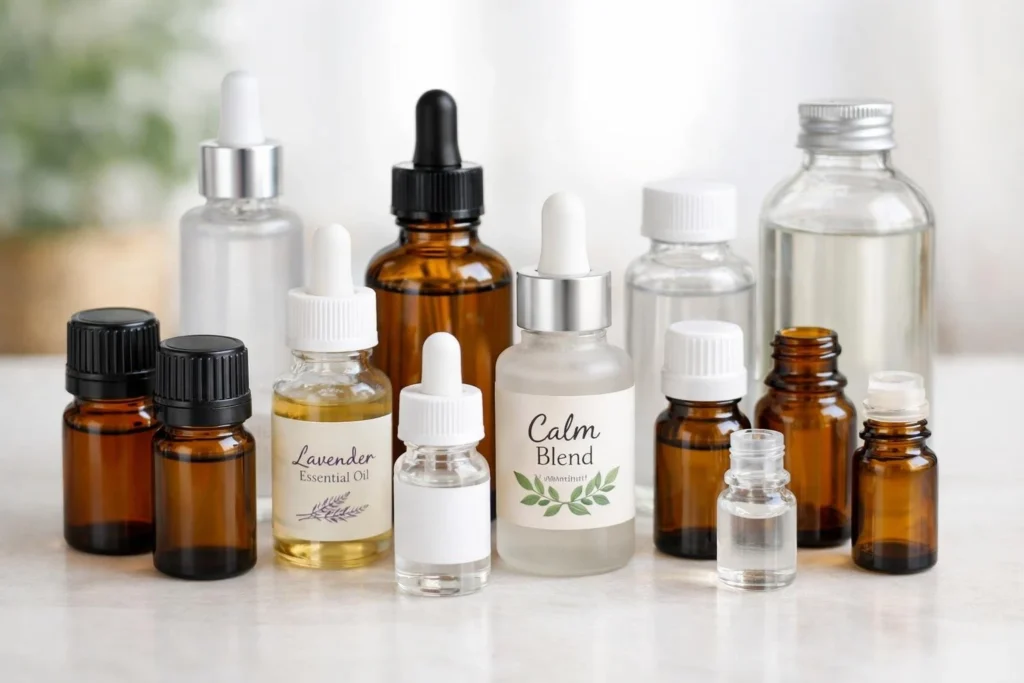
Understanding their structural differences helps prevent compatibility and positioning mistakes.
Euro Dropper Bottles
Euro dropper bottles are the most widely used format worldwide.
They feature a DIN18 neck finish and are designed for use with:
- Orifice reducers
- Child-resistant caps
- Tamper-evident closures
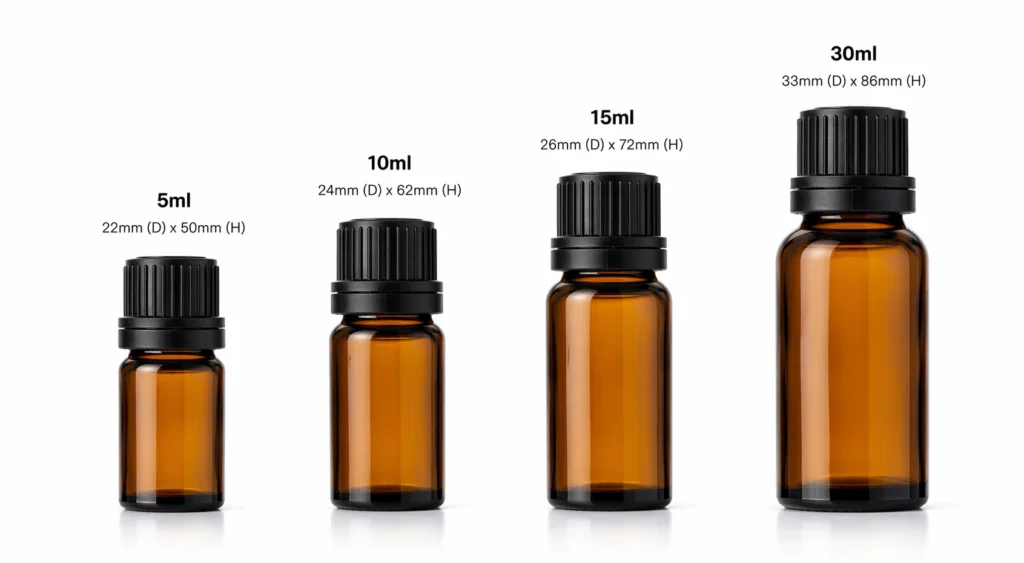
Common capacities include 5ml, 10ml, 15ml, and 30ml.
The ongoing dominance of 10ml essential oil bottles wholesale is driven by consumer familiarity. In most markets, 10ml is perceived as the “standard essential oil size,” making it the safest commercial entry point.
Technical advantages:
- Narrow neck reduces oxygen exposure
- Reducer insert ensures drop-by-drop control
- DIN18 compatibility enables global closure interchangeability
For detailed technical specifications, see What Is DIN18 Neck Finish?
Boston Round Bottles
Boston round essential oil bottles are characterized by rounded shoulders and a cylindrical body.
They are commonly paired with glass pipette droppers rather than reducer inserts.
Typical applications include:
- Cosmetic serums
- Oil blends
- Herbal tinctures
- Premium CBD formulations
Their larger surface area allows more space for labeling, which is particularly important in regulated markets such as cannabis.
For dropper compatibility insights, see Essential Oil Bottles with Dropper Guide.
Roll-On Bottles
Roll-on bottles are designed for direct topical application.
They consist of:
- Glass bottle
- Roller ball (stainless steel or glass)
- Screw cap
Stainless steel rollers provide durability and smooth glide. Glass rollers offer superior chemical inertness.
Roll-on systems are widely used for:
- Aromatherapy blends
- Perfume oils
- CBD topical formulations
For procurement considerations, see Roll-On Bottle Buying Guide.
Dram Bottles
Dram bottles are small-capacity containers primarily used for sampling and promotional campaigns.
They are effective tools for:
- Trial programs
- Subscription boxes
- Product discovery marketing
Sampling strategies reduce acquisition cost and encourage brand exploration.
For more details, see Essential Oil Sampling Packaging Solutions.
Essential Oil Bottle Sizes Guide
Bottle size selection is both a commercial and operational decision.
It influences:
- Retail pricing psychology
- Freight efficiency
- Labeling compliance
- Inventory turnover
- Sustainability positioning
In 2026, successful brands are building multi-tier size strategies rather than relying on a single SKU.
Small-Sized Bottles (1ml – 5ml)
Formats such as 1ml essential oil bottles and 5ml essential oil bottles wholesale are commonly used for:
- Sample distribution
- Rare botanical extracts
- Terpene concentrates
- Travel-size packaging
These small glass oil bottles lower purchase hesitation and increase first-time conversion rates.
However, smaller capacity increases technical sensitivity. Thread tolerance, reducer fit, and liner compression must be precise to avoid leakage.
Medium-Sized Bottles (10ml – 30ml)
Medium formats represent the core of global retail demand.
10ml essential oil bottles wholesale remain the most commercially stable SKU worldwide.
30ml essential oil glass bottles are increasingly popular among:
- CBD brands
- Massage therapy products
- Professional aromatherapists
Medium sizes provide optimal balance between consumer expectations, cost efficiency, and regulatory labeling requirements.
For sizing strategies, see How to Choose Essential Oil Bottle Sizes.
Large-Sized Bottles (50ml – 100ml and Above)
Growing environmental awareness is increasing demand for 50ml essential oil bottles and bulk glass oil bottles.
These formats are suitable for:
- Professional clinics
- Subscription refill systems
- Wholesale CBD distribution
Larger bottles reduce packaging waste per milliliter but require stronger carton protection during export.
Size Comparison Overview
| Size Category | Capacity | Primary Application | 2026 Market Insight |
| Small | 1–5ml | Sampling & rare oils | Growing acquisition tool |
| Medium | 10–30ml | Retail & CBD | Global standard |
| Large | 50–100ml+ | Professional & refill | Sustainability-driven |
How to Choose the Right Size for Your Market
Choosing the right bottle size is not about guessing — it is about aligning packaging with customer behavior and business model.
For Amazon and eCommerce sellers, 10ml essential oil bottles wholesale remain the safest entry point. Consumers are familiar with this format, making price comparison easier and reducing return risk.
Luxury boutique brands often leverage 5ml formats to enhance exclusivity perception. Smaller bottles suggest concentration and craftsmanship, allowing higher margin per milliliter.
CBD brands typically prefer 30ml essential oil glass bottles or 50ml essential oil bottles because customers use these products daily. Larger sizes reduce cost per ml and align with subscription models.
Professional aromatherapists prioritize efficiency and frequently choose bulk glass oil bottles to minimize reorder frequency.
In 2026, sustainability-conscious brands are adopting dual-size strategies — offering 10ml retail bottles alongside refill systems.
When evaluating size, consider:
- Target price positioning
- Frequency of use
- Labeling requirements
- Shipping cost per unit
- Customer lifetime value
If you would like a structured size matrix tailored to your target market, you can Request a Packaging Strategy Consultation.
Glass Colors & UV Protection
Glass color is a functional protection factor, not merely a visual decision.
Essential oils and CBD extracts are photosensitive. UV exposure accelerates oxidation, alters aromatic compounds, and reduces therapeutic effectiveness.
Amber Glass
Amber glass essential oil bottles provide the highest level of UV protection among standard glass colors.
They filter harmful wavelengths that trigger oxidative degradation, significantly extending shelf life.
Amber remains the industry benchmark for therapeutic-grade oils and regulated cannabis products.
Cobalt Blue Glass
Cobalt bottles offer moderate UV protection while delivering strong visual differentiation.
They are popular among boutique and spa-oriented brands seeking premium positioning.
However, for highly sensitive oils, secondary packaging may still be advisable.
Clear Glass
Clear glass offers full transparency but minimal UV protection.
It is best suited for display-focused cosmetic products or controlled indoor environments.
Frosted Glass
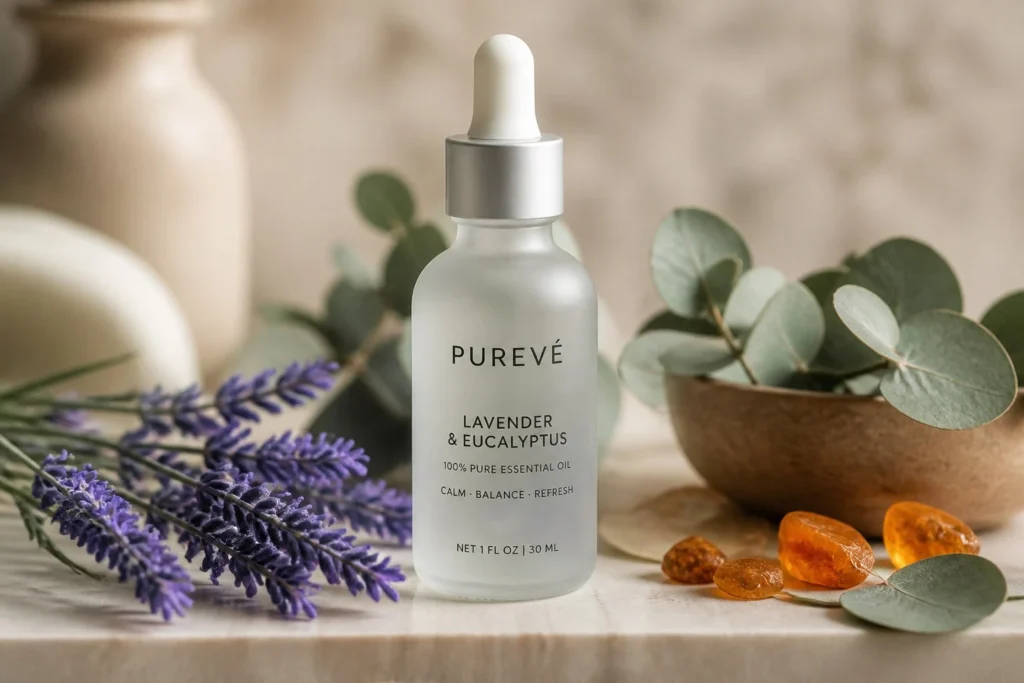
Frosted finishes enhance luxury perception and are widely used in cosmetic packaging.
They do not significantly increase UV protection beyond the base color but add visual sophistication.
Glass Color Comparison
| Color | UV Protection | Brand Positioning |
| Amber | High | Therapeutic & professional |
| Cobalt | Medium | Boutique & premium |
| Clear | Low | Transparent & modern |
| Frosted (Amber/Cobalt) | Based on base color | Luxury |
For deeper comparison insights, see Amber vs Blue Essential Oil Bottles.
If unsure which color suits your formulation, you can Request Glass Samples for Comparison.
Understanding Neck Finish & Compatibility (DIN18 Explained)
Neck finish compatibility is one of the most critical yet overlooked aspects of essential oil packaging.
Many leakage issues originate not from the bottle body, but from thread mismatch and improper sealing.
What Is DIN18?
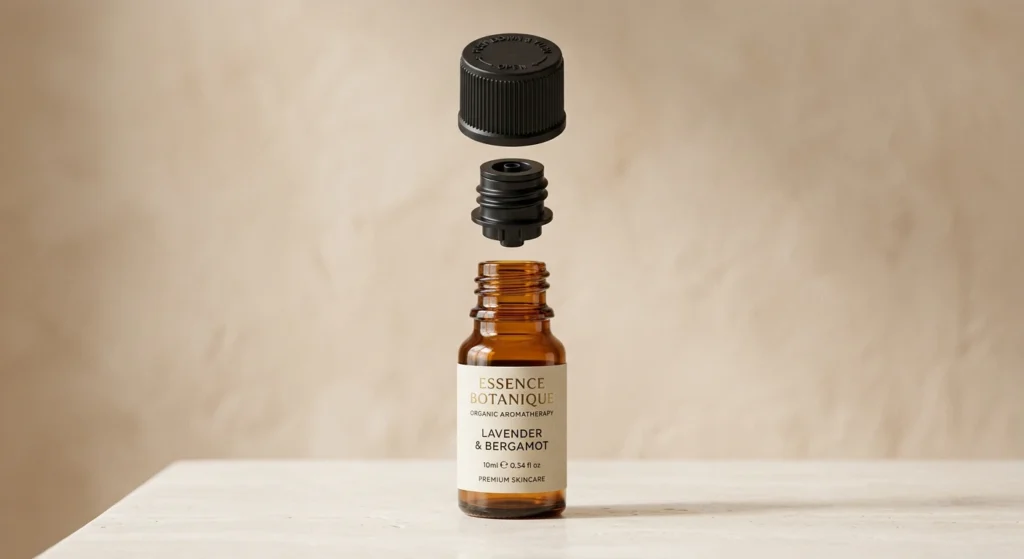
DIN18 essential oil bottles use a standardized 18mm outer thread diameter defined under German industrial standards.
This specification regulates:
- Thread pitch
- Thread depth
- Neck diameter
- Closure fit tolerance
DIN18 ensures global compatibility between bottle, reducer, and cap systems.
Why Compatibility Matters
Even slight tolerance deviation can cause:
- Micro-gaps between cap and neck
- Uneven torque sealing
- Slow evaporation
- Leakage during air freight
- Pressure failure during temperature fluctuations
In regulated CBD markets, leakage can trigger compliance and liability risks.
Common Leakage Causes
- Mixing components from different suppliers
- Using non-standard caps
- Incorrect torque application
- Low-quality liner materials
- Inconsistent neck thickness
Best Practices for Compatibility Assurance
When sourcing essential oil bottles wholesale, confirm:
- Exact DIN18 specification
- Closure liner material
- Insert locking depth
- Torque range recommendations
- Compatibility testing reports
To minimize risk, source bottle, reducer, and cap as a matched system.If you have experienced leakage issues, you can Send Us Your Bottle Sample for Technical Evaluation.
How to Prevent Leakage During Shipping
Leakage during transportation is one of the most common and costly issues in the essential oil industry.
In most cases, leakage is not caused by broken glass. It is caused by improper sealing systems, incompatible components, pressure fluctuations, or inadequate packaging protection.
When shipping essential oil bottles wholesale internationally, products may experience:
- Air pressure changes during air freight
- Temperature fluctuations in sea transport
- Continuous vibration during ground delivery
- Long-term storage before final distribution
Even minor sealing weaknesses can become major failures under these conditions.
Understanding the Real Causes of Leakage
From a manufacturing perspective, leakage typically results from one or more of the following:
- Improper torque during filling
- Mismatched bottle and cap threads
- Low-quality liner materials
- Incomplete reducer insertion
- Inconsistent neck finish tolerances
For CBD oils and cannabis-derived products, leakage risk is even more sensitive due to viscosity differences and regulatory compliance requirements.
Professional Testing Standards
To minimize risk, professional manufacturers implement multiple layers of quality control.
1. Torque Testing
Each closure system must be tightened within a specified torque range.
Under-tightening leads to leakage.
Over-tightening may damage threads or liner compression.
Torque calibration should be validated during pilot production and regularly monitored during mass filling.
2. Inverted Storage Testing
Finished bottles are stored upside down for 24–72 hours.
This simulates long-term contact between oil and closure seal, helping identify micro-leakage before shipment.
3. Drop Testing
Cartons are dropped from specified heights to simulate handling impact.
This ensures internal dividers and bottle systems remain intact during real-world logistics.
4. Carton Compression Testing
Stacking pressure during sea freight can compress cartons for weeks.
Compression testing verifies structural stability under sustained weight.
Packaging Reinforcement Strategies
For international export, protective measures include:
- Customized inner dividers
- Molded pulp trays
- Partitioned carton systems
- Shrink band sealing for tamper protection
- Palletized shipments with stretch wrapping
For high-value CBD or cosmetic oils, additional secondary packaging (such as retail boxes) adds another layer of stability.
Best Practice Recommendation
The safest strategy is to source bottle + reducer + cap as a matched system from a single manufacturer.
Mixing components from different suppliers significantly increases tolerance mismatch risk.
If you have experienced leakage issues before, you can Send Us Your Current Bottle Sample for Technical Evaluation. Our engineering team can analyze compatibility and sealing performance before you place your next bulk order.
Reliable sealing is not optional — it protects your product, your customers, and your brand reputation.
Custom Essential Oil Bottles Wholesale & Private Label
In today’s competitive aromatherapy, CBD, and cosmetic markets, packaging is one of the strongest brand differentiation tools.
Customization transforms standard essential oil bottles into premium branded assets.At YPC Packaging, we provide full-service custom essential oil bottles wholesale solutions, starting from 3,000 pieces.
Why Customization Matters in 2026
Consumers are increasingly drawn to:
- Visually distinctive packaging
- Premium tactile finishes
- Sustainable material positioning
- Brand storytelling through design
In saturated online marketplaces, packaging often determines whether a customer clicks, purchases, or repeats.
Custom packaging supports:
- Higher retail margins
- Stronger brand recognition
- Increased perceived product value
- Reduced price comparison pressure
Decoration & Finishing Options
We offer multiple decoration techniques to match different brand positioning strategies.
Screen Printing
Direct printing on glass provides:
- Durable branding
- Scratch resistance
- Clean professional appearance
Ideal for therapeutic and CBD markets.
Hot Stamping
Metallic foil stamping creates:
- Luxury accents
- Premium shelf presence
- High-end cosmetic appeal
Common in boutique and gift-focused brands.
Spray Coating & Color Customization
Custom color coating allows full brand differentiation beyond standard amber or cobalt.
Popular options include:
- Matte black
- Frosted white
- Soft pastel tones
- Gradient finishes
Frosted Finishes
Frosted surfaces elevate tactile and visual perception.
Frequently used in skincare and luxury aromatherapy packaging.
Custom Closures & Branding Elements
Beyond the bottle itself, we provide:
- Custom logo caps
- Printed or embossed closures
- Custom color droppers
- Matching outer packaging boxes
A consistent bottle + closure + outer packaging system strengthens overall brand identity.
Custom Mold Development
For established brands seeking exclusivity, we offer custom mold development.
Advantages include:
- Unique bottle silhouettes
- Trademarked design identity
- Market differentiation
Custom mold projects typically require higher volume commitment but provide long-term competitive advantage.
MOQ & Production Timeline
Our standard minimum order quantity:
3,000 pieces per SKU.
Production timeline:
- Stock bottles: 7–15 days
- Customized production: 25–35 days
- New mold development: 45–60 days
We recommend planning production at least 2–3 months before major seasonal launches.
Quality Control in Custom Projects
Customization does not reduce quality control standards.
Each production batch undergoes:
- Dimensional inspection
- Decoration adhesion testing
- Color consistency verification
- Closure compatibility testing
This ensures your branded packaging performs as well as it looks.
Strategic Advice for New Brands
If you are launching your first essential oil product line:
- Start with a standard mold to reduce upfront investment
- Customize through printing and closure design
- Validate market response
- Consider custom mold development after scaling
This phased strategy reduces risk while preserving brand uniqueness.
If you are planning a new product launch or expanding into CBD or cosmetic segments, you can Request a Custom Quotation Today to discuss:
- Bottle type selection
- Decoration options
- Cost simulation
- Lead time planning
Professional customization is not just aesthetic — it is a strategic growth investment.
How to Choose a Reliable Essential Oil Bottle Supplier
When sourcing essential oil bottles wholesale, evaluate:
- Production capacity
- Quality inspection standards
- Leak testing procedures
- Export experience
- Compatibility assurance
At YPC Packaging, we combine manufacturing expertise with cannabis and cosmetic regulatory familiarity.
You can Request Samples to Evaluate Quality Before Ordering.
FAQs About Essential Oil Bottles
What is the best bottle for essential oils?
Amber glass essential oil bottles with DIN18 neck and CRC caps.
What size sells best?
10ml essential oil bottles wholesale remain the global standard.
What is DIN18?
A standardized neck thread ensuring closure compatibility.
What is the MOQ?
MOQ starts at 3,000 pieces.
Conclusion: Essential Oil Bottle Buying Checklist
Before confirming your order, verify:
- Bottle type
- Size strategy
- Glass color
- DIN18 compatibility
- Closure system
- Leak testing standards
- MOQ and lead time
- Shipping protection
Selecting the right essential oil bottles wholesale supplier protects product integrity and supports sustainable brand growth.
If you are sourcing premium glass essential oil bottles for cannabis or cosmetic applications, Contact YPC Packaging Today for Samples & Pricing.