
Child-Resistant Caps Explained: Push & Turn vs Squeeze vs Snap Types
Child-resistant caps have saved countless lives by keeping dangerous products out of children’s hands. These safety closures use clever mechanisms that make them tough for kids to open, but adults can still manage them.
Whether you’re picking packaging for medications, household cleaners, or cannabis products, knowing the differences between cap types helps you choose the right protection for your needs.

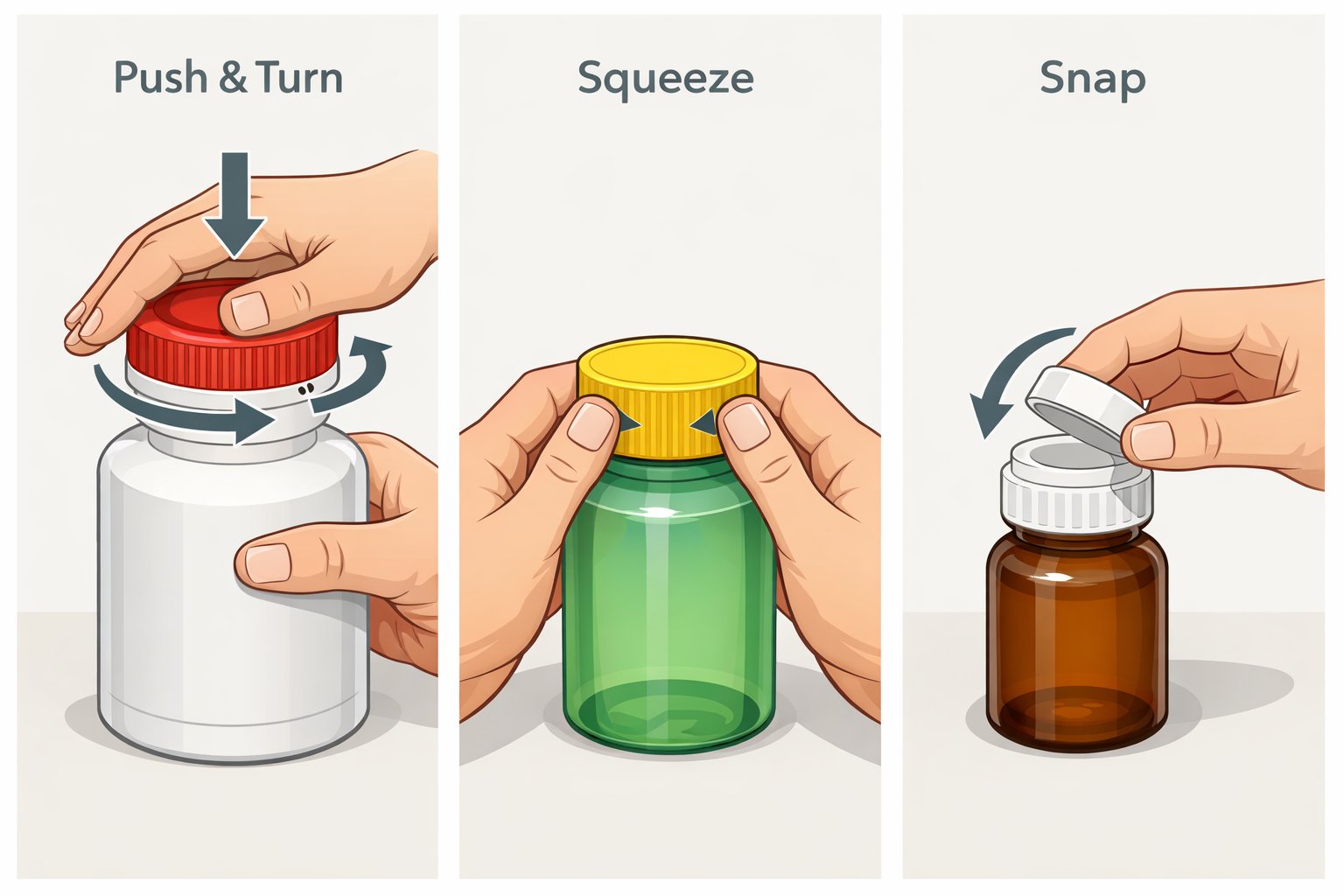
The three main types of child-resistant caps are push-and-turn caps, squeeze-and-turn caps, and snap caps. Push-and-turn caps require downward pressure and rotation, squeeze-and-turn caps need you to squeeze at specific spots while twisting, and snap caps use alignment tabs or arrows with a prying motion.
Each design creates a barrier that challenges young kids’ motor skills but stays manageable for adults. Push-and-turn caps are the classic choice for pharmaceuticals, but squeeze and snap designs sometimes work better for different containers or products.
Your choice isn’t just about safety. The right cap has to fit your container’s neck, meet legal standards like ASTM F1888, and actually work for your users.
Some designs use less plastic, and certain mechanisms are easier for people with limited hand strength. It’s a balancing act that’s trickier than it looks.
Key Takeaways
- Child-resistant caps use push-and-turn, squeeze-and-turn, or snap designs to keep kids under five from opening containers.
- Each cap type has its own perks based on container size, product, and user needs, while still meeting safety standards.
- Picking the right cap means matching it to your bottle and making sure it’s both safe and easy enough for adults to use.
How Child-Resistant Caps Work and Why They Matter
Child-resistant caps use mechanical challenges that most young kids just can’t figure out, which helps cut down on accidental poisoning. These safety closures have to pass strict tests and follow regulations to make sure they protect kids under five but stay usable for adults.
Origin and Purpose of Child-Resistant Packaging
The Poison Prevention Packaging Act of 1970 kicked off child-resistant packaging rules in the U.S. Before that, thousands of kids ended up in the hospital—or worse—every year from accidental poisoning.
Manufacturers created child-resistant closures to keep children from accidentally swallowing dangerous stuff. These caps target the specific skills that kids under five don’t have. Most young children just can’t manage the multi-step opening process.
The law covers prescription meds, over-the-counter drugs, and household chemicals. Since then, child poisoning deaths have dropped dramatically. These closures really do stand between hazardous products and curious little hands.
Child-Resistant Cap Design Principles
Designers build child-resistant caps to require steps that young kids can’t pull off. Your cap needs at least two actions at once—or in sequence—that call for fine motor skills and a bit of problem-solving.
Key design elements include:
- Multiple simultaneous actions – Like push down while turning, or squeeze while twisting
- Precise alignment – Internal lugs line up with channels only when you do it right
- Required force – Enough resistance to stump kids, but not so much that adults struggle
- Cognitive barriers – Instructions or visual cues that don’t make sense to little ones
Good design depends on knowing what kids can and can’t do at different ages. Kids under five usually can’t coordinate both hands or follow a bunch of steps in the right order. Your child-resistant closure takes advantage of those developmental gaps, but adults should still be able to open it without too much hassle.
Child-Resistant Packaging – Regulations & Standards
ASTM F1888 is the main testing standard for child-resistant packaging in North America. Testers use panels of children aged 42 to 51 months and adults aged 50 to 70 years.
Testing requirements include:
| Test Group | Opening Rate Limit | Time Frame |
|---|---|---|
| Children (first attempt) | Maximum 15% | 5 minutes |
| Children (after demonstration) | Maximum 20% | 5 minutes |
| Adults | Minimum 90% | 5 minutes |
The Consumer Product Safety Commission (CPSC) makes sure manufacturers follow these rules for pharmaceutical packaging and household chemicals. You need certification before you can sell products with child-resistant caps where regulations apply.
ISO 8317 sets international standards that other countries use. Cannabis products in legal markets now have to use child-resistant closures that meet or beat these tests.
Role of Tamper-Evident Seals in Safety
Tamper-evident seals add another layer of safety by showing if someone opened your package before you bought it. These seals work hand-in-hand with child-resistant caps.
Common tamper-evident features are breakaway bands, shrink sleeves, and induction seals. When you use both a tamper-evident seal and a child-proof cap, you protect against tampering during shipping and accidental opening at home.
Pharmaceutical packaging almost always combines both. The tamper seal keeps the product safe from the factory to your hands, while the child-resistant cap keeps kids out at home. It’s smart to check that both are intact before you use any medication or hazardous product.
Comparing Push & Turn, Squeeze, and Snap Child-Resistant Caps
Each child-resistant closure (CRC) uses a different trick to keep kids out but let adults in. The push-and-turn cap lines up internal parts, squeeze-and-turn caps need you to squeeze at certain spots, and snap closures make you align and pry in just the right way.
Push & Turn Caps: Mechanism and Applications
Push-and-turn closures are everywhere in the pharmaceutical and supplement world. You push down on the cap to line up the inside lugs with the bottle’s threads, and only then can you twist it open.
These usually have two pieces—the outer shell spins freely until you push down, which grabs the inner cap and lets you unscrew it. That combo makes it really tough for kids under five to get in.
You’ll spot push-and-turn caps on prescription bottles, over-the-counter meds, and vitamins. They fit standard bottle necks and give reliable protection if you close them properly. The design checks all the boxes for the Poison Prevention Packaging Act (PPPA) and 16 CFR 1700 rules.
Squeeze-and-Turn Cap Features
Squeeze-and-turn caps need you to press on specific sides while twisting. This double-action unlocks internal locks that keep the cap from turning normally. They’re especially handy for wide-mouth containers where pushing down isn’t practical.
You squeeze at the marked spots, which releases tabs or a locking ring inside. Keep squeezing, twist, and the cap comes off. Most kids don’t have the hand strength or coordination to do both at once.
These caps often use less plastic because they’re usually single-piece designs. You’ll see squeeze-and-turn caps on household chemicals, cannabis jars, and some vitamins. Some adults even find them easier to open than push-and-turn types, especially if their grip isn’t what it used to be.
Snap Closures: Function and Use Cases
Snap closures ask you to line up arrows, tabs, or markers, then pry the cap open. This takes visual-motor skills and dexterity that little kids just don’t have yet.
These closures snap shut tight when you close them. To open, you find the right marks, get your fingers in place, and apply force in a specific direction. It’s not easy for a child to figure out.
You’ll find snap closures on cannabis edibles, some personal care items, and supplement jars. They work for products that don’t use standard threaded bottles. Snap designs look modern and offer both tamper evidence and child resistance in a neat little package.
Compliance Standards and Testing Procedures
All child-resistant caps have to pass tough tests before you can use them for regulated products. The Consumer Product Safety Commission enforces the Poison Prevention Packaging Act, which sets the bar for how these closures perform. Testing follows standards like ISO 8317 internationally and ASTM F1888 in the U.S.
Testers use two groups: kids aged 42 to 51 months try to open the package, and adults have to open and reclose it. For PPPA, at least 85% of kids must fail to open it in five minutes on the first try. Also, 80% of adults need to open and close it properly.
Your packaging has to meet these numbers, no matter which type of closure you use. Push-and-turn, squeeze-and-turn, and snap closures all get the same treatment. Certification proves your child-resistant cap actually works for safety and adult usability.
Compatibility: Neck Finish, Threads & Liner Fit
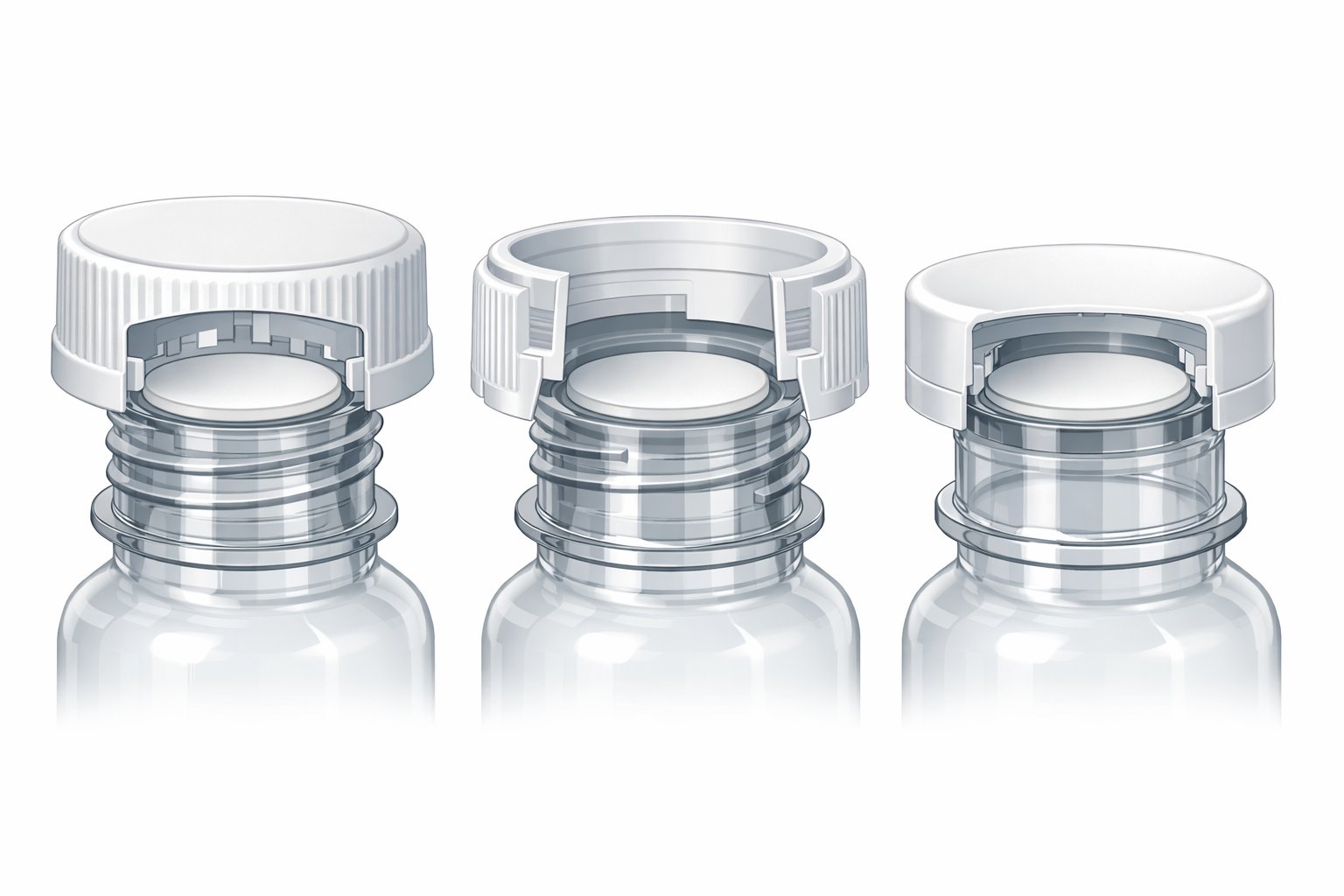
Child-resistant caps need to match the bottle’s neck finish, have the right threading, and use the correct liner to seal well. If you get the combo wrong, you might end up with leaks, failed child resistance, or caps that just don’t fit at all.
Common neck finishes you support
Most child-resistant caps use continuous thread (CT) neck finishes. These have standardized sizing.
The measurement system uses two numbers. The first shows the cap diameter in millimeters, and the second tells you the thread style.
Standard CR-Compatible Neck Finishes:
- 38-400: Common for pharmaceutical and supplement bottles
- 45-400: Used for wider mouth containers and bulk products
- 28-400: Standard for smaller bottles and liquid medications
- 33-400: Mid-size option for various applications
Child-resistant closures need extra neck finish features beyond just threading. You’ll notice locking mechanisms, higher ridges for push-down use, and tighter tolerances that help the two-motion opening system work.
The neck has to be tall enough to catch the locking tabs inside the cap. At the same time, it needs enough clearance for that familiar push-and-turn motion.
Liner materials and when to use PTFE/silicone/foam
Your liner choice really matters for seal quality and chemical compatibility. Some materials can handle certain substances better than others, so it’s worth thinking about.
PTFE (Teflon) stands up to harsh chemicals, acids, and volatile solvents. This liner shrugs off corrosive materials that would break down other types. You’ll want PTFE for high-purity chemicals, oils, or products that need sterilization. The downside? It’s pricier.
Foam liners (F217) fit general uses like household products, cosmetics, and many pharmaceuticals. These compress to prevent leaks, but they don’t make an airtight seal. They’re affordable and work with metal, plastic, or glass containers. Don’t use foam with hydrocarbon solvents like paints or adhesives—they just can’t handle those.
Pressure-sensitive (PS22) foam liners stick to the container rim when you first put the cap on. They’re great for dry goods and powders, and they show tamper evidence without fancy equipment. Their shelf life runs about six months, and they’re not reliable with liquids.
Frequently Asked Questions
Child-resistant caps use specific mechanisms and have testing requirements. It’s not surprising if you’ve got questions about how they work or how to use them correctly.
Understanding these safety features helps you pick the right closure for your needs. Sometimes the details really do matter.
What are the typical challenges associated with child-resistant closures?
The biggest challenge? Balancing child safety with adult accessibility. You want a cap that keeps kids out but doesn’t frustrate everyone else.
Some adults—especially seniors or those with arthritis—struggle with the strength and coordination needed for push-and-turn or squeeze-and-turn caps. That’s a real concern, since tricky closures might tempt people to leave caps off, which defeats the whole point.
Cost can be an issue, too. Child-resistant caps require more complex manufacturing, so your packaging expenses go up. Testing and certification also add to the bill.
How do push and turn child-resistant caps function to prevent child access?
Push and turn caps use a two-step process that’s tough for young children. You have to press down and turn at the same time to open the bottle.
Inside the cap, little lugs or gears line up with channels in the bottle neck only when you push down. That’s when you can rotate and open it.
This design calls for coordinated motor skills, which most kids under five just don’t have yet. Adults find the motion pretty natural, but for kids, it’s a solid barrier. I’d say it’s clever engineering.
What are the safety features of squeeze-top child-resistant containers?
Squeeze-top containers make you press at specific points on the sides of the cap before it’ll open. Random squeezing won’t do the trick.
The caps usually have raised grip spots so you know where to press. When you squeeze those, tabs inside let go, and then you can lift or turn the cap open.
Lots of squeeze-top designs have a hinge that keeps the cap attached to the bottle. That’s handy—no more lost caps, and you can reseal the bottle fast.
Can you explain the differences between push & turn and snap-top child-resistant caps?
Push and turn caps make you press down and rotate at the same time. Snap-top caps take a different route—you line up arrows or tabs, then pry the cap open.
The main difference? Push and turn caps use rotation against threads, while snap-tops rely on friction-fit or locking tabs that you pull or lift at certain points.
Snap-tops often show up on wide-mouth containers and products like cannabis edibles or supplements. Push and turn caps stick with pharmaceuticals because they fit standard bottle necks so well.
Are there specific standards that child-resistant caps must meet to be considered safe?
ASTM F1888 is the big U.S. standard for child-resistant caps. This test uses panels of kids and adults to see if the packaging really works.
They test 200 children aged 42 to 51 months. At least 85% of them have to fail to open the package for it to pass. Meanwhile, at least 90% of adults must open and properly reclose the package.
The Consumer Product Safety Commission (CPSC) enforces these rules under the Poison Prevention Packaging Act. Your caps need official certification before you can legally sell them in most markets.
What steps should be followed to properly secure a bottle with a child-resistant cap?
Line up the cap with the bottle threads before closing. Place the cap on the bottle opening, press down, and turn clockwise.
Keep turning until you feel resistance and the cap stops. Don’t force it past that point—over-tightening can mess up the threads or make removal a pain later.
Try to take off the cap without using the child-resistant mechanism. If it comes off easily, you didn’t close it right, so do it again.
How does the design of child-resistant caps impact their effectiveness?
The way you have to open a cap really shapes how well it keeps kids out. Caps that make you do two things at once—like push and twist—usually block children better than those with a single action.
Material choice matters, too. You want plastics tough enough to handle being opened and closed a bunch of times, but still flexible enough so the locking parts actually work.
Good cap designs throw in visual or tactile hints for adults, like little bumps or arrows. These help grown-ups figure it out, but don’t make it too obvious for kids.