
Child-Resistant Options for Glass Concentrate Jars: Compliance Guide
A Child-Resistant jar is a special type of container made to be hard for children to open but still usable for adults. These jars are often used for glass concentrate products because safety is very important. A Child-Resistant jar helps reduce the risk of kids opening products that may not be safe for them.
Many businesses think that using any tight lid is enough, but that is not true. A real Child-Resistant jar must follow safety rules and pass testing. These rules are different in the United States, Canada, and other countries. If the jar does not meet the rules, it can cause legal trouble, recalls, or lost sales.
In this guide, you will learn what a Child-Resistant jar really is, how it works with glass jars, what types of child-resistant caps exist, and how to choose the right option.
What a Child-Resistant Jar Really Means (Not Child-Proof)
A Child-Resistant jar is made to slow down or stop children from opening it. This does not mean the jar can never be opened by a child. It means most children cannot open it within a short time. This is why it is called child-resistant, not child-proof.
Safety laws focus on how the Child-Resistant jar performs during testing. Children are given the jar and a set time to try to open it. If most children cannot open it, the jar passes. Adults are also tested to make sure they can still open and close the jar without trouble.
Many people think a strong or tight lid makes a jar child-resistant. That is a common mistake. A Child-Resistant jar must use a special opening action. This often includes pushing down and turning, squeezing and turning, or using two actions at the same time. Without this design, the jar is not considered child-resistant.
Another important point is that a Child-Resistant jar must work every time it is closed. If the jar only works once and then becomes easy to open, it may not meet safety rules. This is why many markets prefer jars that stay child-resistant for the full life of the product.
When a Child-Resistant Jar Is Required
A Child-Resistant jar is required when a product could be harmful if a child opens it. The exact rules depend on the country, state, or region where the product is sold. This is why businesses must always check local laws before choosing packaging.
In many places, a Child-Resistant jar is required for cannabis concentrates and extracts. These products often look small and interesting, which can attract children. Safety laws are designed to lower the risk of accidents by making the jar hard for kids to open.
Some health, beauty, and chemical products also need a Child-Resistant jar. This includes strong creams, oils, or liquids that should not be touched or swallowed by children. Even if the product is natural, it may still need child-resistant packaging.
In some markets, the law allows child-resistant packaging only at the time of sale. This is called initial child resistance. In other markets, the Child-Resistant jar must stay child-resistant every time it is opened and closed. This is known as lifetime child resistance.
Compliance Standards for a Child-Resistant Jar (US, Canada, EU and UK)
A Child-Resistant jar must meet safety rules before it can be sold. These rules explain how the jar is tested and what makes it child-resistant. The rules are different in each region, but the goal is always the same: protect children while allowing adults to use the product.
United States
In the United States, a Child-Resistant jar is usually tested under safety rules set by the government. During testing, children are given the jar and a short time to try to open it. If most children cannot open it, the jar passes. Adults are also tested to make sure they can open and close the jar without pain or struggle.
For glass concentrate packaging, many companies choose a Child-Resistant jar that has already been tested to these rules. This helps avoid delays, fines, or product recalls.
Canada
In Canada, many regulated products must be sold in a Child-Resistant jar. The packaging must be hard for children to open and often must include a tamper-evident feature. This helps consumers see if the jar has already been opened.
Canada often expects the Child-Resistant jar to remain child-resistant for the full life of the product, not just the first opening. Because of this, reclosable child-resistant caps are commonly used.
EU and UK
In the EU and UK, a Child-Resistant jar is usually tested under international safety standards. These standards focus on reclosable packaging that stays child-resistant after repeated use.
If a product uses a one-time sealed package instead of a reclosable jar, a different test method may be used. This is why it is important to match the packaging type to the correct safety standard.

Best Child-Resistant Jar Closure Options for Glass Concentrate Jars
Choosing the right cap is one of the most important steps when selecting a Child-Resistant jar. The cap controls how the jar opens and closes, and it decides whether the jar is safe and compliant.
Push-Down-and-Turn Caps
Push-down-and-turn caps are one of the most common options for a Child-Resistant jar. To open the jar, the user must push the cap down and then turn it at the same time. Most children cannot do both actions together.
These caps are widely accepted and easy to recognize. They work well with many glass jar sizes and are often used for products that need lifetime child resistance.
Squeeze-and-Turn Caps
Squeeze-and-turn caps require the user to squeeze the sides of the cap while turning it. This type of Child-Resistant jar can be easier for adults to open, especially when the jar is small.
These caps still provide strong child resistance, but the material quality must be good. If the cap bends too easily, it may lose its safety function.
Press-Tab and Special Action Caps
Some Child-Resistant jar designs use press tabs, arrows, or special grip points. These caps require two actions before opening. They can offer a modern look, but they must always be tested to confirm they meet safety rules.
Secondary Child-Resistant Packaging
In some cases, the glass jar itself is not child-resistant, but it is placed inside a child-resistant pouch or box. This method may work in some regions, but not all laws allow it. Always confirm if secondary packaging is accepted where you sell.
Testing a Child-Resistant jar: What “Certified” Really Means
Many people think a Child-Resistant jar is certified just because the supplier says so. This is not always true. A real child-resistant claim must be backed by proper testing and clear documents.
Testing checks how hard it is for children to open the jar and how easy it is for adults to use. During the test, children are given the Child-Resistant jar and a short amount of time to try to open it. If most children fail, the jar passes. Adults are also tested to make sure the jar is not too hard to open.
It is important to understand that testing is done on a full package system. This means the glass jar, the child-resistant cap, and the liner inside the cap are all tested together. If any of these parts change, the Child-Resistant jar may no longer be valid.
Some suppliers only provide a short letter or label that says “child-resistant.” This is risky. You should always ask for a full test report. The report should show the jar size, cap type, liner type, and testing method used.
A Child-Resistant jar is only compliant when it matches the exact setup that was tested. Using the right documents helps protect your business and your customers.
Engineering Factors That Make or Break a Child-Resistant jar
A Child-Resistant jar can fail even if it uses the right cap. Small design and production details play a big role in safety. Paying attention to these factors helps keep the jar compliant and easy to use.
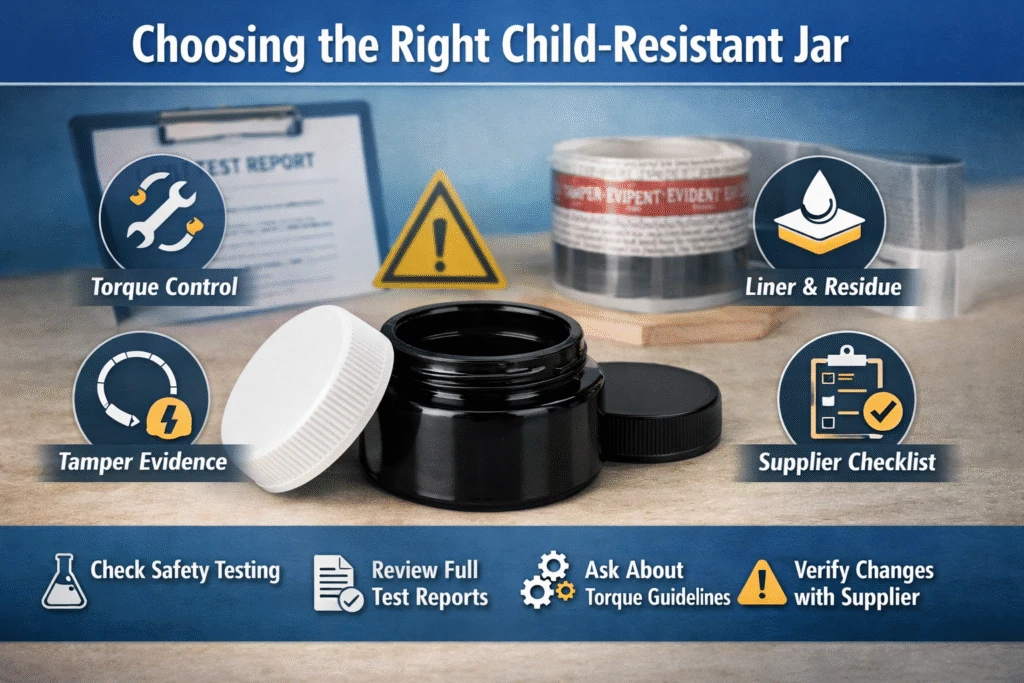
Torque and Opening Force
Torque is how tightly the cap is screwed onto the jar. If the torque is too low, children may be able to open the Child-Resistant jar. If the torque is too high, adults may struggle or hurt their hands.
Manufacturers must control torque during filling and capping. The goal is to keep the jar hard for children but comfortable for adults to open.
Liner Choice and Product Residue
The liner inside the cap helps seal the jar. Some concentrate products are sticky and can move into the threads over time. This can make the Child-Resistant jar harder to open than expected.
Choosing the right liner helps prevent leaks and keeps opening force stable during the product’s shelf life.
Tamper Evidence
Tamper evidence is a feature that shows if the jar was opened before purchase. While it is not always required, it is strongly recommended for many products.

Supplier Checklist for Buying a Child-Resistant Jar
Choosing the right supplier is just as important as choosing the right Child-Resistant jar. A good supplier should clearly explain how their packaging meets safety rules and should provide proof when asked.
When talking to a supplier, start by asking if their Child-Resistant jar has been tested. Ask what safety standard was used and whether the testing was done on the same jar size, cap, and liner you plan to use.
You should also ask for a full test report, not just a short statement. The report should show details such as jar size, cap type, liner material, and test method. This helps confirm the Child-Resistant jar is truly compliant.
Next, ask about torque guidelines. The supplier should tell you how tight the cap must be applied to keep the child-resistant feature working. Without this information, the jar may fail in real use.
Finally, ask about changes. If the supplier changes the cap material, liner, or design, the Child-Resistant jar may need new testing. A good supplier like YPC packaging will warn you before making any changes.
Common Mistakes When Using a Child-Resistant Jar
Even with good intentions, many businesses make mistakes when using a Child-Resistant jar. These mistakes can cause safety issues, failed inspections, or customer complaints.
One common mistake is assuming any child-resistant cap will work. Not all caps fit all jars. If the threads do not match perfectly, the Child-Resistant jar may open too easily or not work at all.
Another mistake is changing parts without thinking about testing. Switching liners, cap materials, or jar finishes may seem small, but it can break the child-resistant function. A Child-Resistant jar must match the exact setup that was tested.
Some companies rely only on exit bags or outer packaging. While this may work in some places, other markets require the jar itself to be child-resistant. Using the wrong approach can lead to fines or product removal.
Poor torque control is also a big issue. If caps are applied too loosely or too tightly, the Child-Resistant jar may fail for children or adults.
Conclusion: How to Choose the Right Child-Resistant Jar
Choosing the right Child-Resistant jar is about safety, trust, and compliance. A good jar helps protect children while still being easy for adults to use. It also helps your business avoid legal problems and product recalls.
Start by understanding the rules in the markets where you sell. Then choose a Child-Resistant jar that fits those rules, not just one that looks child-resistant. Make sure the jar, cap, and liner have been tested together and that you receive proper test reports.
Work with suppliers who are open and clear about their products. Ask questions, control torque during filling, and avoid changing parts without review. Small details matter when it comes to child-resistant packaging.
When done right, a Child-Resistant jar adds real value to your product. It improves safety, builds customer confidence, and supports long-term success.
Looking for a reliable Child-Resistant jar solution you can trust?
YPC Packaging offers tested glass concentrate jars and child-resistant caps designed to meet safety standards while keeping your product protected and professional.